Kilimanjaro sits at 3 degrees south of the equator. It doesn't have four seasons. It has two wet periods, two dry periods, and a mountain that generates its own weather by forcing moist air 5,895 meters straight up. The standard advice — "go in January or August" — is a simplification that serves operator scheduling more than it serves climbers.
The actual picture requires looking at each month, understanding what the five climate zones do differently in each season, and deciding what matters more: warm summit temps, dry trails, or empty campsites.
The two trekking windows
Kilimanjaro's calendar splits into two recognized dry seasons:
January to early March — the "short dry season." Follows the short rains of November-December. Warmer temperatures at altitude. Lower precipitation than the wet months but not bone-dry. Fewer climbers than the main season.
June to October — the "long dry season." Follows the long rains of March-May. Coldest months at the summit. Driest conditions on the mountain. Peak crowds in July and August.
Between these windows sit the two rainy seasons: the long rains (masika) from mid-March through May, and the short rains (vuli) from late October through December. Most operators either don't run climbs during the long rains or run them at steep discounts with clear warnings about conditions.
Sources: Climbing-Kilimanjaro.com — Best Time to Climb, Altezza Travel — Weather by Month
Continue reading Kilimanjaro Routes Compared: Success Rates, Days, and Which One to Pick →
Month-by-month breakdown
| Month | Base (Moshi) | Summit night | Precipitation | Crowd level | Verdict |
|---|---|---|---|---|---|
| January | 28-30C | -7 to -12C | Moderate (60mm) | Medium | Good. Clear skies common, warm summit |
| February | 28-31C | -5 to -10C | Moderate (60mm) | Low-Medium | Excellent. Warmest summit temps of the year |
| March | 27-30C | -7 to -15C | High (130mm) | Low | Risky. Rains begin mid-month |
| April | 24-27C | -7 to -15C | Very high (250mm) | Very low | Avoid. Peak long rains |
| May | 23-26C | -10 to -18C | High (180mm) | Very low | Avoid. Rains tailing off but trails saturated |
| June | 23-26C | -10 to -20C | Low (30mm) | Medium | Good. Dry season begins, cold summit |
| July | 22-25C | -12 to -20C | Very low (20mm) | High | Driest month. Crowds building |
| August | 23-26C | -12 to -20C | Very low (20mm) | Very high | Driest, most crowded, coldest |
| September | 25-28C | -10 to -18C | Low (30mm) | Medium-High | Good. Crowds thinning, still dry |
| October | 27-30C | -8 to -15C | Moderate (60mm) | Medium | Variable. Short rains may start late month |
| November | 27-30C | -7 to -12C | High (100mm) | Low | Unpredictable. Short rains active |
| December | 28-30C | -7 to -12C | Moderate (80mm) | Medium-High | Mixed. Holiday surge mid-month |
Sources: Mountain Forecast — Kilimanjaro, Climb Kilimanjaro Guide — Weather, NOAA Climate Data — East Africa
Note the summit temperature range. February averages -5 to -10C on summit night. August averages -12 to -20C. That's a 10-degree difference at the point where most climbers are at their physical limit, sleep-deprived, oxygen-starved, and making the final push between midnight and sunrise. Cold is not a minor variable at 5,895 meters. It's a direct contributor to turnarounds.
April and May: the long rains
Most operators suspend or heavily discount climbs from mid-March through May. This is not overcaution. The masika rains dump 250mm+ on Kilimanjaro's southern slopes in April alone. The rainforest zone (1,800-2,800m) becomes a mud channel. The moorland zone (2,800-4,000m) is fog-bound for days. Visibility at higher elevations drops. Trails on the Machame and Umbwe routes — already steep — become genuinely dangerous when wet.
The Marangu route (the only route with hut accommodation) stays marginally more viable because of its drier northern approach and solid shelter. But "marginally more viable" is not a recommendation. Success rates in April are the lowest of any month.
A handful of operators still run climbs during these months, typically at 20-30% discounts. The trade-off is real: lower cost, emptier mountain, worse odds.
Source: Ultimate Kilimanjaro — Seasons
November: the overlooked shoulder
The short rains (vuli) are less intense than the long rains but less predictable. November can deliver a week of afternoon showers or a sustained washout — there's no reliable pattern. The mountain receives roughly 100mm of precipitation, concentrated in the lower zones.
The upside: November has some of the lowest crowd levels of any trekking month. Camp allocations on popular routes like Machame and Lemosho are easy to secure. Guide-to-climber ratios improve because operators have excess staff relative to demand.
The downside: the unpredictability makes planning difficult, and travel insurance underwriters are less flexible with claims when you knowingly book during a rainy season.
December: transition into holiday chaos
Early December often carries residual short rains. By mid-December, conditions stabilize and the mountain enters a brief dry window that coincides with the Christmas and New Year holiday rush. Prices spike 15-25% for departures between December 20 and January 5. Camp sites on Machame fill to capacity. The Barafu high camp — shared by Machame, Lemosho, and Umbwe routes — becomes a bottleneck, with hundreds of climbers launching summit bids on the same night.
December is not a bad month for weather. It is a bad month for crowds and pricing if you book the holiday window.
Source: Altezza Travel — High Season Pricing
The contrarian case for February
Every major operator's website pushes July and August as the "best time to climb." The data tells a more nuanced story.
February offers:
- Warmest summit temperatures of the year. The -5 to -10C range is survivable in standard expedition gear. August's -12 to -20C requires significantly better insulation and increases cold injury risk.
- Moderate precipitation. February sees roughly 60mm — three times July's 20mm, but concentrated in afternoon showers in the lower zones. Above 4,000m, precipitation is minimal.
- Lower crowds than the peak season. July and August account for approximately 30% of all annual Kilimanjaro summits. February accounts for roughly 8-10%. Camp sites are less congested. Summit night on Uhuru Peak is not a headlamp queue.
- Better glacier visibility. Kilimanjaro's remaining glaciers (Furtwangler, Northern Icefield, Southern Icefield) are retreating at roughly 1% per year. In February, they're more photogenic — less obscured by cloud cover compared to the thick cloud banks that build during the June-August dry season's temperature inversions.
The reason operators push July and August is operational, not meteorological. Peak northern hemisphere summer vacation drives demand. Operators staff up for July-August, build fixed departures around those months, and fill group treks to capacity. February requires marketing a less familiar window to climbers who default to "summer holiday."
None of this makes February risk-free. An unlucky week can bring sustained rain into the moorland zone. But the statistical weather profile is strong, and the experience on the mountain — fewer people, warmer nights, clearer mornings — is measurably better for most climbers.
Sources: Climb Kilimanjaro Guide — February Weather, Climbing-Kilimanjaro.com — Best Time
Five climate zones, one mountain, different seasonal behavior
Kilimanjaro's five ecological zones each respond to seasons differently. Understanding this matters for packing and expectations:
Cultivation zone (800-1,800m) — Hot and humid year-round. Rain patterns mirror Moshi's lowland weather. Not a factor for most trekkers who drive through it.
Rainforest zone (1,800-2,800m) — Wet in every season. Even in July, the driest month, the forest canopy drips. Expect mud on the first day regardless of when you climb. Gaiters are not optional.
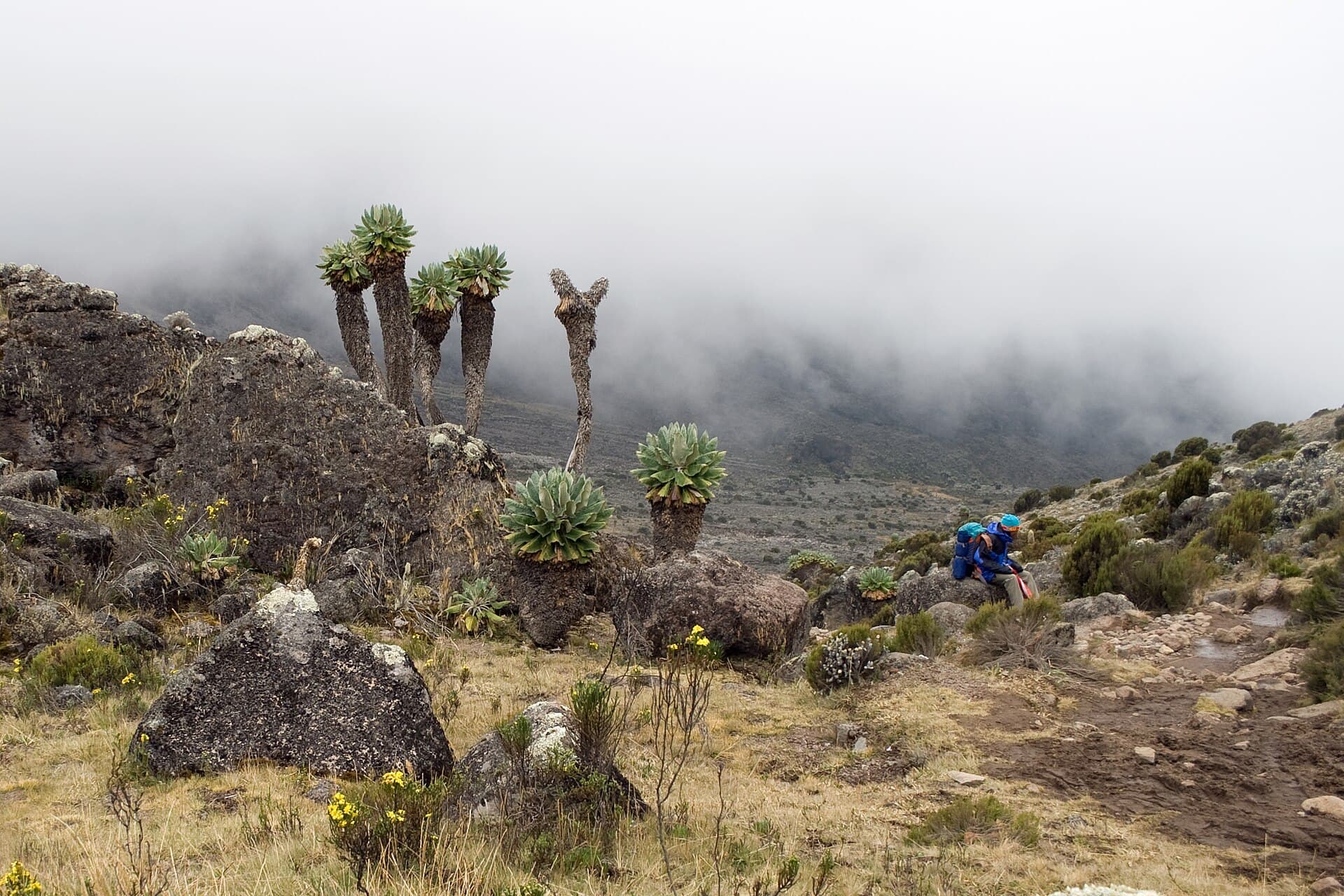
Moorland/heather zone (2,800-4,000m) — The transition zone. Dry season brings clear skies and cold nights. Wet season brings fog, drizzle, and reduced visibility. This is where the seasonal difference is most dramatic.
Alpine desert (4,000-5,000m) — Dry year-round. Precipitation at this altitude is rare in any month. The air holds almost no moisture. UV exposure is extreme. Temperature swings from +15C in afternoon sun to -15C at night are normal.
Arctic/summit zone (5,000-5,895m) — Below freezing year-round. The seasonal variation here is about wind and temperature severity, not rain. February summit nights are cold. August summit nights are brutal.
Source: Kilimanjaro National Park — Ecological Zones, Altezza Travel — Climate Zones
Summit visibility from Moshi
For those basing in Moshi before or after a climb — or for photographers — Kilimanjaro's summit is visible from town only in the early morning. Clouds build from the southeast starting around 9-10am and typically obscure the peak by midday. The best window for a clear view of Uhuru Peak and Mawenzi from Moshi is 6:00 to 9:00am, and this holds true across all seasons.
During the dry season (June-October), the morning window is slightly more reliable. During the wet months, even the early morning can be cloud-covered for days at a stretch.
Source: Altezza Travel — Moshi Guide
Booking lead times
How far ahead to book depends entirely on the season:
July-August (peak): Book 3-6 months in advance. Popular routes (Machame, Lemosho) on 7-8 day itineraries fill their camp allocations. Operators with the best reputations (Altezza, Follow Alice, Ultimate Kilimanjaro) sell out group departures by March-April for a July-August climb.
January-February: Book 1-2 months ahead. Availability is rarely an issue. Some operators offer last-minute spots with 2-3 weeks notice.
December holidays: Book 4-6 months ahead. The Christmas window is a compression event — high demand in a narrow 2-week period.
Shoulder months (June, September, October): Book 1-3 months ahead. Good availability, competitive pricing.
Rainy season (April-May, November): Often bookable on short notice. Some operators offer 10-30% discounts. Confirm the operator actually runs climbs in these months before assuming availability.
Source: Follow Alice — Booking Guide
Summary
The "best" month to climb Kilimanjaro depends on what you optimize for:
- Driest conditions: July. Twenty millimeters of precipitation across the entire month. Cold summit, crowded camps.
- Warmest summit: February. Ten degrees warmer than August at the top. Moderate rain in lower zones, manageable crowds.
- Fewest people: April-May. Almost empty. Also almost unclimbable in heavy rain years.
- Best balance: Late January, early February, or September. Each offers a different trade-off between weather, crowds, and cost.
The operators will tell you July and August. The weather data says February deserves more attention than it gets. The mountain is there year-round. The question is which version of it you want to meet.
6 Sources
- whc.unesco.orgUNESCO World Heritage Centre — Kilimanjaro National Park
- meteo.go.tzTanzania Meteorological Authority (TMA) — official national met service
- climateknowledgeportal.worldbank.orgWorld Bank Climate Change Knowledge Portal — Tanzania historical climatology (CRU/ERA5)
- tc.copernicus.orgCullen et al. 2013, The Cryosphere — A century of ice retreat on Kilimanjaro: the mapping reloaded
- esd.copernicus.orgEarth System Dynamics (Copernicus) 2020 — Mesoscale atmospheric circulation controls of meteorological elevation gradients on Kersten Glacier near Kilimanjaro summit
- soctropecol.euHemp & Hemp 2003, ECOTROPICA 9:71–97 — high-altitude grasslands on Mt. Kilimanjaro