The World's Most Accessible Extreme Altitude
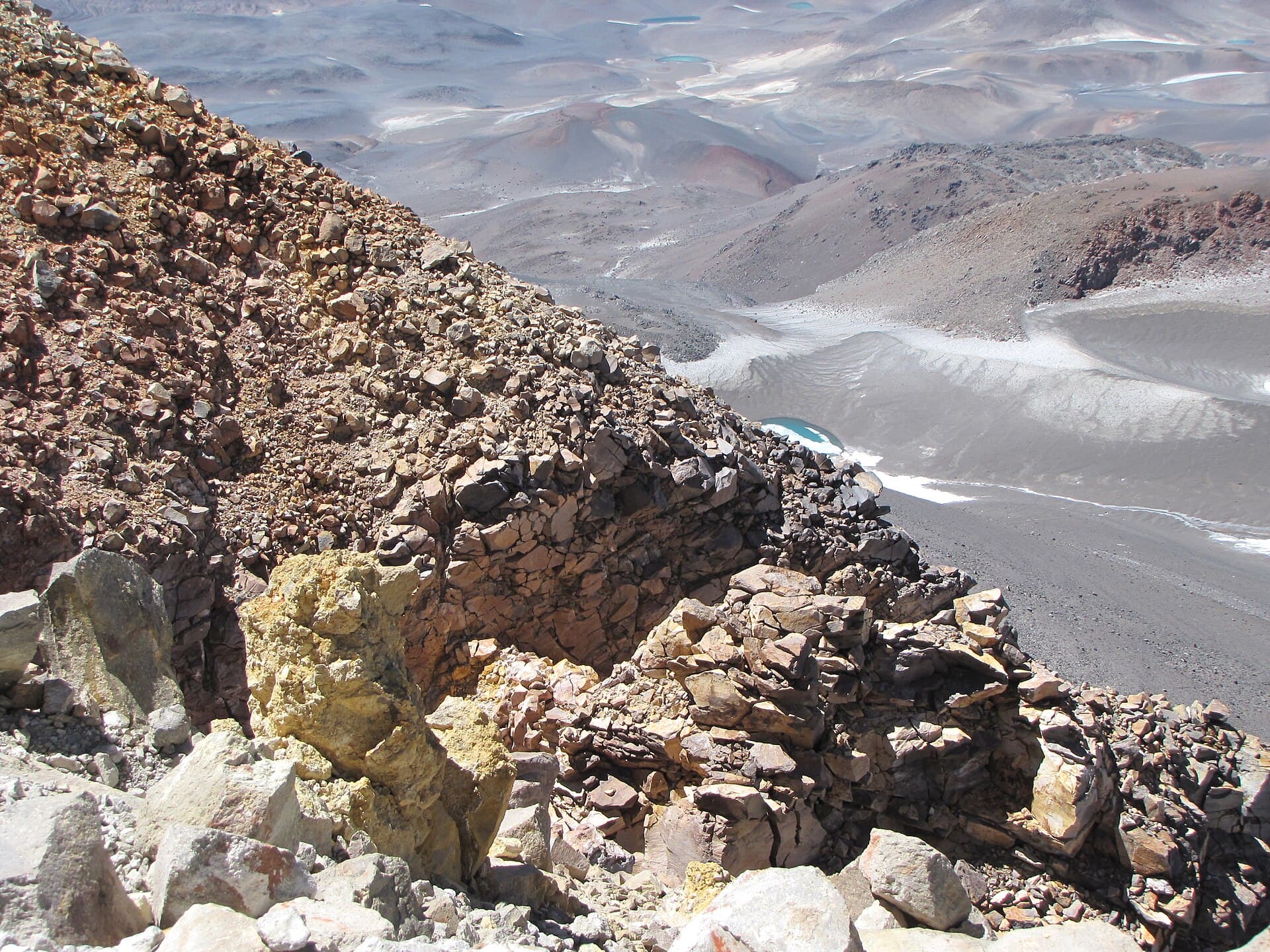
The Puna de Atacama holds 39 peaks above 6,000 metres. Almost all of them are non-technical. The Argentine side charges zero permit fees. The region sees roughly 600 climbers per year, total, across every peak -- compared to 3,500-4,000 permits issued annually for Aconcagua alone. A guided expedition to the highest volcano on Earth costs about half what Aconcagua costs for 98.7% of the altitude. The blue dollar is dead. Lithium mining is paving the roads. And almost nothing about this has been reported accurately in English.
Three peaks define the Puna 6Ks for most climbers: Ojos del Salado (6,893m), Monte Pissis (6,793m), and Volcan San Francisco (6,018m). They sit in Catamarca Province, the northwest corner of Argentina, straddling the Chilean border along Ruta Nacional 60 -- a corridor called the Ruta de los Seismiles because it passes between nearly twenty summits exceeding 6,000 metres within 200 kilometres. This is the second-highest concentration of peaks on Earth after the Himalaya, accessed from a town of 2,400 people that most Argentines have never visited.
The Three Peaks
Ojos del Salado — 6,893m
The highest volcano on Earth and the second-highest peak in the Western Hemisphere, 68 metres short of Aconcagua. The Smithsonian's Global Volcanism Program classifies it as active, though the last confirmed eruption was approximately 750 CE. Fumaroles still emit sulfur below the summit. In November 1993, observers at a Chilean police post 30 km away watched a gray column of water vapour and solfataric gases rise intermittently for three hours. The Smithsonian lists that event as "unconfirmed." Whether Ojos del Salado is "active" depends on your threshold for the word.
At 6,480 metres, inside the summit crater, sits a lake approximately 100 metres in diameter -- probably the highest lake on Earth. A creek feeding it reaches 40.8 degrees Celsius, heated by residual geothermal energy. This is the Atacama Desert, the driest non-polar place on the planet, and there is a warm lake near the top of it.
The route from either side is non-technical hiking over scree and volcanic sand until the final approach. Then: 100 metres of 35-degree snow slope requiring crampons, followed by a chimney pitch at approximately 6,850m graded UIAA II / YDS 5.6 on loose, rotten volcanic rock. Fixed ropes exist on the Chilean route in three sections. At sea level, 5.6 climbing is trivial. At 6,850 metres with -25 degrees and 80 km/h winds, it becomes a serious mountaineering problem. Success rate: approximately one-third of attempts.
A modified car reached 6,688m on Ojos del Salado in 2015 -- the highest a car has ever driven on Earth. On the Chilean side, 4x4 vehicles routinely reach 5,800 metres. This is not remote wilderness in the traditional sense. It is extreme altitude with road access to within 1,100 vertical metres of the summit.
Monte Pissis — 6,793m
The second-highest volcano in the world and third-highest peak in the Western Hemisphere. Entirely within Argentina. First climbed on February 7, 1937 by the Polish mountaineers Stefan Osiecki and Jan Alfred Szczepanski. The second ascent did not happen until 1985 -- a 48-year gap -- because the mountain was inaccessible until mining roads penetrated the area.
That gap tells the story. Pissis has zero refugios, zero fixed ropes, zero infrastructure of any kind above the 4x4 track to base camp at 4,600m. The route crosses a glacier starting at 5,900m -- unusual for the driest desert on Earth -- and navigates a penitentes field before ascending a high caldera crater to the summit ridge. A January 2026 expedition report documents the full route at 12.71 km one-way from base camp with +2,187m elevation gain.
Pissis is technically easier than Ojos del Salado -- no summit scramble, alpine grade F -- but logistically harder. The 4x4 transfer from Fiambala involves 14 hours of driving with no trail to follow and requires river fording. Only about four operators worldwide run guided expeditions here. The mountain sees perhaps a few dozen climbers per year.
For collectors targeting the "Second Seven Summits" or volcano completionists, Pissis is the genuine expedition. It is what Ojos del Salado was before the Chilean refugio system existed.
Volcan San Francisco — 6,018m
The gateway. First climbed in 1913 by German geologist Walther Penck. Vehicle access reaches approximately 5,000 metres on summit day. The route gains +1,182m over 6.61 km one-way from the Paso de San Francisco border crossing. Non-technical. No glacier, no crampons, no ice axe. Cairns throughout. "No possibility of getting lost," according to a January 2026 expedition report. Round trip in 9-10 hours.
Most operators use San Francisco as an acclimatization peak before Ojos del Salado -- it appears as Day 5 of the standard Madison Mountaineering itinerary. But it is also a legitimate stand-alone objective: a 6,000-metre summit for under $1,000 with a local EPGAMT-certified guide, or $3,932 through Andes Vertical for the full 10-day package with hotel, 4x4, and all meals. The summit holds Inca ceremonial structures -- two circle-shaped stone formations from the capacocha tradition, evidence that pre-Columbian people reached 6,016m without modern equipment.
San Francisco is arguably the best-value first 6,000-metre peak on Earth.
Continue reading Volcan San Francisco — The Gateway 6K for $830 →
The Aconcagua Comparison
Every article about the Puna 6Ks positions them against Aconcagua. The comparison is valid but usually overstated. The claim that Ojos del Salado costs "one-fifth" or "one-third" of Aconcagua circulates widely in English-language trekking content. The real number is approximately half.
The math
The permit savings are real and significant. Aconcagua charges foreign climbers $1,170 (with operator) to $1,640 (independent) for the 2025/2026 season Normal Route permit. The Puna 6Ks charge nothing. Zero. Catamarca Province has no permit system, no fee structure, and no quota system. On the Chilean side, the DIFROL permit is free, processed online with 20+ business days lead time.
Guided expedition costs diverge less dramatically. A mid-range guided Ojos del Salado expedition from the Chilean side runs $3,980-4,200. A comparable Aconcagua expedition runs $6,750. Factoring in domestic flights, insurance, ground transport, accommodation, and gear rental:
| Category | Aconcagua (mid-range guided) | Ojos del Salado (Chilean, mid-range guided) |
|---|---|---|
| Permit | $1,170-1,640 | $0 |
| Guided expedition | $6,750 | $3,980 |
| Domestic flights | $200 | $300 |
| Insurance | $400 | $350 |
| Accommodation, ground, gear | $850 | $350 |
| Total | $9,370-9,840 | $4,980 |
Sources: Andes Specialists, Andes Vertical Aconcagua fee schedule, Explore-Share
Ojos del Salado costs roughly 50-55% of Aconcagua when comparing like-for-like guided expeditions. The "one-fifth the cost" narrative only works if Aconcagua's high-end independent total ($10,000-12,000) is cherry-picked against Ojos' zero-permit floor. That comparison is real but misleading.
The savings come from three places: zero permits (saves $1,170-1,640), lower operator prices (saves $1,500-3,000), and no mandatory evacuation insurance surcharge. But the "cheap 6K" framing breaks down when independent climbing on the Argentine side is attempted -- the 62 km approach from asphalt with no refugios, no drivable road, and route maps that one experienced operator describes as "purely made by fantasy and absolutely wrong" creates costs in self-sufficiency, 4x4 transport, and mule hire that close the gap.
The Altitude-Per-Dollar Calculation
Strip the comparison down to its irreducible metric: how much altitude can be purchased per dollar spent?
| Peak | Summit Elevation | Approximate Total Cost (guided) | Metres per $1,000 |
|---|---|---|---|
| Ojos del Salado | 6,893m | $5,000 | 1,379m |
| Aconcagua | 6,961m | $9,500 | 733m |
| Denali | 6,190m | $10,000 | 619m |
| Elbrus | 5,642m | $4,500 | 1,254m |
| Kilimanjaro | 5,895m | $3,500 | 1,684m |
Kilimanjaro wins on raw metres-per-dollar, but tops out at 5,895m. Ojos del Salado is the only peak on Earth that delivers extreme altitude -- above 6,800m -- for under $6,000 total cost. For climbers whose goal is maximum altitude without Himalayan prices, Himalayan logistics, or Himalayan crowds, nothing else competes.
Sources: Andes Specialists, Skyhook Aconcagua cost, Explore-Share
The Rescue Vacuum
This is the section most trekking content omits. The Puna's cost advantage comes with a corresponding gap in safety infrastructure.
There is no dedicated mountain rescue helicopter in Catamarca Province. Aconcagua has military helicopter evacuation, park rangers at multiple camps, and a base-camp-to-hospital time of 2-4 hours. The Puna has none of this. A climber who develops pulmonary or cerebral oedema at Camp 2 on Pissis (5,900m) faces this evacuation path:
- Carry or walk the patient to base camp (4,600m) -- multiple hours
- 4x4 drive 5-7 hours over rough terrain to Cortaderas or Fiambala
- Treatment at Hospital Interzonal "Luis Agote" in Fiambala -- a Level 1 facility with emergency room, X-ray, lab, and 10 beds, inaugurated in 2023
- For complex cases, 4.5-hour ambulance transfer to San Fernando del Valle de Catamarca (320 km)
Best case from incident to hospital: 12+ hours. Without Global Rescue membership or equivalent evacuation insurance, a helicopter rescue -- if one could even be organised from Catamarca capital or Copiapo -- could exceed $100,000.
For comparison: Aconcagua has military helicopter evacuation, park rangers at multiple camps, and a base-camp-to-hospital time of 2-4 hours. The nearest city is Mendoza, population one million, three hours away. Fiambala has 2,400 people, zero cell coverage above town, and no dedicated mountain rescue. The cost advantage and the safety gap are the same thing.
The Lithium Economy Is Reshaping Access
The Puna de Atacama sits at the heart of the lithium triangle -- the Argentina-Chile-Bolivia region holding over half the world's lithium reserves. Catamarca Province is a major player. In the first eight months of 2025, Argentina's lithium exports totalled USD 494 million, with 32% year-on-year value growth and 56% volume growth. Catamarca officials project 15 operating lithium plants by 2035.
This is directly affecting mountain access through road infrastructure.
Provincial Route 43 (Antofagasta de la Sierra to the Salta border) -- the gateway road for Monte Pissis and the northern Puna 6Ks -- is being paved. Total scope: 112 km. The first 5 km were completed in April 2026, with Section I at 15% physical progress. Funding comes from mining royalties and direct contributions from POSCO (US$1M), Rio Tinto, Pan American Energy, and Galan Lithium -- all operating lithium projects in the Salar del Hombre Muerto basin.
Route 43 unpaved is a notorious bottleneck: washboard gravel, no services, seasonal closures. Paved, it will cut transit times to Pissis base camp substantially and open the area to non-4WD vehicles. Mining roads in the broader Puna have already improved 4x4 access to remote areas that were previously expedition-only terrain.
The environmental trade-off is real. Over 25+ years of extraction at the Salar del Hombre Muerto, the Trapiche River has dried up. In March 2024, a Catamarca court suspended authorisation for new lithium projects near the salar. Whether that ruling holds in a province that depends on mining revenue is an open question. The Puna's remoteness is being eroded by the same economic forces that make lithium batteries possible.
The "Highest Volcano" Debate
Every operator markets Ojos del Salado as "the world's highest active volcano." The title sells expeditions. The truth is more qualified.
No confirmed eruption has occurred in recorded human history. The last eruption was approximately 750 CE, plus or minus 250 years. The "active" classification comes from persistent fumarolic activity -- sulfurous emissions documented since the 1937 Polish expedition -- and the ambiguous November 1993 event, when a grey column was observed from 30 km away but no satellite deformation was detected.
By eruption-based definitions, Llullaillaco (6,739m, last erupted 1877) has a stronger claim to "highest active volcano." Cotopaxi (5,897m, erupted 2015) is unambiguously active but shorter. The Smithsonian classifies Ojos del Salado as Holocene, placing it in the "active" category, but notes no confirmed historical eruptions.
The distinction matters less than what it reveals about the mountain's geology: Ojos del Salado is not extinct. The crater lake at 6,480m, the hot creek, the fumaroles -- these are signs of a geothermal system that is alive. The mountain is dormant, not dead, and that makes it more interesting than either the marketing ("climb an active volcano!") or the dismissal ("it hasn't erupted in 1,300 years") would suggest.
The summit elevation itself is contested -- surveys have produced 6,893m, 6,891m, 6,887m, and 6,879m. Monte Pissis underwent a 90-metre downward revision in 2005 when DGPS corrected the 1994 GPS reading from 6,882m to 6,793m. For a decade, that inflated figure had circulated as fact.
The 1937 Polish Expedition
The story of high-altitude mountaineering in the Puna de Atacama is, remarkably, a Polish story.
The Second Polish Andean Expedition (1936-1937), led by journalist Justyn Wojsznis, targeted the Ojos del Salado region along the Argentina-Chile border. The team included Stefan Osiecki, an architect and painter returning from the earlier First Expedition, and Jan Alfred Szczepanski, a journalist.
On February 7, 1937, Osiecki and Szczepanski reached the summit of Monte Pissis. Nineteen days later, on February 26, Szczepanski and Wojsznis summited Ojos del Salado, leaving a cairn and recording sulfurous fumaroles 200 metres below the top -- the first documented evidence of the volcano's ongoing activity. Two of the three highest volcanoes on Earth, first-climbed in the same month, by the same small expedition.
Most of the expedition's maps and reports were lost during World War II, creating a documentation gap that fuelled decades of controversy. Later Austrian climbers found the Polish cairn was not at the exact summit -- it may have been on a subsidiary point. The Andean Club of Chile ultimately ruled the 1937 expedition as the legitimate first ascent.
Monte Pissis was not climbed again until 1985. That 48-year gap between first and second ascent -- longer than the gap between the Wright brothers' flight and the Moon landing -- is the single most telling fact about the Puna's remoteness. The second ascent only became possible after mining roads penetrated the area. The same economic forces reshaping the region today are the ones that made it accessible at all.
The earlier First Polish Andean Expedition (1933-1934) had already established Polish credibility in the Andes with the first ascent of Mercedario (6,720m) and a new eastern route on Aconcagua -- still known as the Polish Glacier.
The Invierno Boliviano
This is the hidden season-killer that English-language guides consistently miss.
The climbing season for the Puna 6Ks runs November through March. Most operators schedule departures in January and February, marketed as "peak summer" and "best weather." Most SEO articles recommend the same months. This advice is dangerously incomplete.
The invierno boliviano (Bolivian winter, also called invierno altiplanico) is a meteorological phenomenon in which moisture from the Amazon basin pushes south into the Puna during January and February, causing sudden thunderstorms, heavy snow, and whiteout conditions at high altitude. It is well known to Argentine and Chilean mountaineers. It is almost never mentioned in English-language planning guides.
| Month | Suitability | Notes |
|---|---|---|
| Nov | Opening | Season starts. Colder but stable. Some early expeditions |
| Dec | Best window | Warming. Pre-invierno-boliviano stability. Most reliable weather |
| Jan | Prime but risky | Warmest daytime temps. Invierno boliviano risk: sudden storms from Amazon moisture |
| Feb | Prime but risky | Peak invierno boliviano. Same storms, sometimes worse |
| Mar | Second-best window | Storms subside. Still warm. Fewer climbers. Days shortening |
| Apr | Marginal | Short days, cold nights, unpredictable |
Sources: SummitPost, Wikipedia, AllMountain Chile
Operators push January-February because that is when most foreigners take holidays. The mountain itself prefers early December and March. Any article or operator that recommends "January and February are the best months" without an asterisk about the invierno altiplanico is either uninformed or filling departure dates.
The Puna's broader weather threat is not storms in the Nepal sense. It is relentless dry cold and wind with no shelter. Temperature swings of 30-40 degrees in 12 hours are normal. Wind gusts at summit level reach 200 km/h. Mean annual summit temperature: -10 degrees.
The Border Crossing Problem
The Paso de San Francisco (4,726m) -- the only land crossing connecting the Argentine and Chilean approaches -- is chronically unreliable. In the 2025-2026 season alone: closed late December 2025 for landslide risk, closed February 25, 2026 for adverse weather, closed April 14-15 for snow accumulation. New restricted hours effective May 4, 2026: La Gruta (Argentine control) 09:00-18:00, last vehicle toward Chile at 16:30. The pass is impassable roughly May through October. The Chilean approach from Copiapo avoids this bottleneck entirely.
The Operator Landscape
Guided expedition pricing for Ojos del Salado in 2026 ranges from $2,500 to $8,950, a 3.6x spread for essentially the same mountain.
| Operator | Price (USD) | Days | Route | Source |
|---|---|---|---|---|
| High Mountain LA | ~$2,500 | 6-14 | Chilean | highmountainla.com |
| Andes Specialists | $3,980 (group) | 14 | Chilean | andes-specialists.com |
| Chile Montana | $4,200 | 13 | Chilean | chilemontana.com |
| SummitClimb | $4,350 | 14 | Chilean | summitclimb.com |
| Andes Vertical | $4,790-4,900 | 14 | Argentine | andes-vertical.com |
| Alpenglow Expeditions | $8,950 | 9 | Chilean | alpenglowexpeditions.com |
The Alpenglow premium buys a 9-day trip instead of 14 via 28 days of pre-acclimatization using Hypoxico altitude tents at home. For high-earning professionals, the time savings may justify the markup. Everyone else has 14 days and $4,000.
An independent climber on the Argentine side can do it for $1,200-2,000 -- with their own gear, extensive expedition experience, and comfort with self-rescue as the only option.
The Currency Reality
Argentina's monetary landscape has changed dramatically. In April 2025, most capital controls (the cepo cambiario) were lifted. The blue dollar -- which traded at a 50-100% premium over the official rate during 2022-2024 -- now trades only modestly above the official rate. Any budget guide from 2022-2024 recommending "bring US dollars and change at the blue rate" is outdated. Credit and debit cards at the official rate are competitive. Carry ARS cash equivalent of $200-300 USD for Fiambala incidentals. Cards work for the large purchases.
What has changed recently
Five claims that appear across top-ranking English-language results and are inaccurate as of May 2026:
- "Ojos del Salado costs 1/5 of Aconcagua." It costs roughly half when comparing like-for-like guided expeditions. The 1/5 figure cherry-picks Aconcagua's most expensive scenario against Ojos' permit-free floor.
- "January and February are the best months." They are the warmest months. They are also the months most affected by the invierno boliviano. December and March are more stable.
- "Highest active volcano in the world." Depends on the definition of "active." No confirmed eruption in recorded history. Fumaroles and a 1993 ambiguous event are the basis for the claim. Llullaillaco (6,739m, erupted 1877) has a stronger eruptive case.
- "Easy climb / walk-up." Mostly true to 6,700m. The final 200 metres involve a snow slope requiring crampons and a UIAA II rock scramble at extreme altitude with severe wind exposure. Calling this a "walk-up" to someone whose hardest climb is Kilimanjaro is irresponsible.
- "No permits required on the Argentine side." True in the sense that no fee is charged. Misleading in that Gendarmeria registration is required for border-zone access, and tourist police registration in Fiambala is expected. "No permits" implies nobody is tracking climbers, which is not entirely accurate.
Summary
The Puna de Atacama is not Aconcagua-lite. It is a different paradigm of high-altitude mountaineering -- one defined by solitude, aridity, zero infrastructure, and the cognitive dissonance of reaching nearly 7,000 metres in a landscape that looks like Mars.
Climbers who want a "conquering" narrative will find it underwhelming. There is no permit counter to queue at, no base camp village, no summit certificate industry. Climbers who want to stand in one of the most desolate places humans can reach under their own power -- 39 peaks above 6,000 metres, 600 people a year, roads paved by lithium money leading into a desert where Polish mountaineers left cairns that went unvisited for half a century -- will find it unforgettable.
The mountain does not need hype. It needs accurate information. This is the start.
23 Sources
- volcano.si.eduSmithsonian Global Volcanism Program -- Nevados Ojos del Salado (Tier 1)
- volcano.si.eduSmithsonian GVP -- November 1993 Report (Tier 1)
- en.wikipedia.orgWikipedia -- Ojos del Salado (Tier 1)
- en.wikipedia.orgWikipedia -- Monte Pissis (Tier 1)
- en.wikipedia.orgWikipedia -- 1930s Polish Andean Expeditions (Tier 1)
- andes-specialists.comAndes Specialists -- Ojos del Salado Expedition (Tier 2)
- andes-vertical.comAndes Vertical -- Aconcagua Fee Rates 2025/2026 (Tier 2)
- andes-vertical.comAndes Vertical -- Monte Pissis Expedition (Tier 2)
- andes-vertical.comAndes Vertical -- San Francisco Volcano (Tier 2)
- guidedpeaks.comGuidedPeaks -- Ojos del Salado Complete Guide (Tier 2)
- explore-share.comExplore-Share -- Ojos del Salado Facts (Tier 2)
- summitpost.orgSummitPost -- Ojos del Salado (Tier 2)
- madisonmountaineering.comMadison Mountaineering -- Ojos del Salado (Tier 2)
- pakocrestas.wordpress.compakocrestas -- Pissis January 2026 Report (Tier 2)
- pakocrestas.wordpress.compakocrestas -- San Francisco January 2026 Report (Tier 2)
- panorama-minero.comPanorama Minero -- Route 43 Paving (Tier 2)
- aida-americas.orgAIDA -- Court Decision Stops Lithium Mining in Argentine Salt Flat (Tier 2)
- catamarcactual.com.arCatamarca Actual -- Paso San Francisco Closure (Apr 2026) (Tier 2)
- catamarcactual.com.arCatamarca Actual -- Paso San Francisco Schedule Changes (Tier 2)
- hir.harvard.eduHarvard International Review -- The Lithium Triangle (Tier 2)
- dialogue.earthDialogue Earth -- Argentina Lithium Mining (Tier 2)
- alexclimb.comAlexClimb -- Ojos del Salado from Argentina 2023 (Tier 2)
- trade.govTrade.gov -- Argentina Eliminates Capital Controls (Tier 2)