Volcan San Francisco: The Gateway 6K
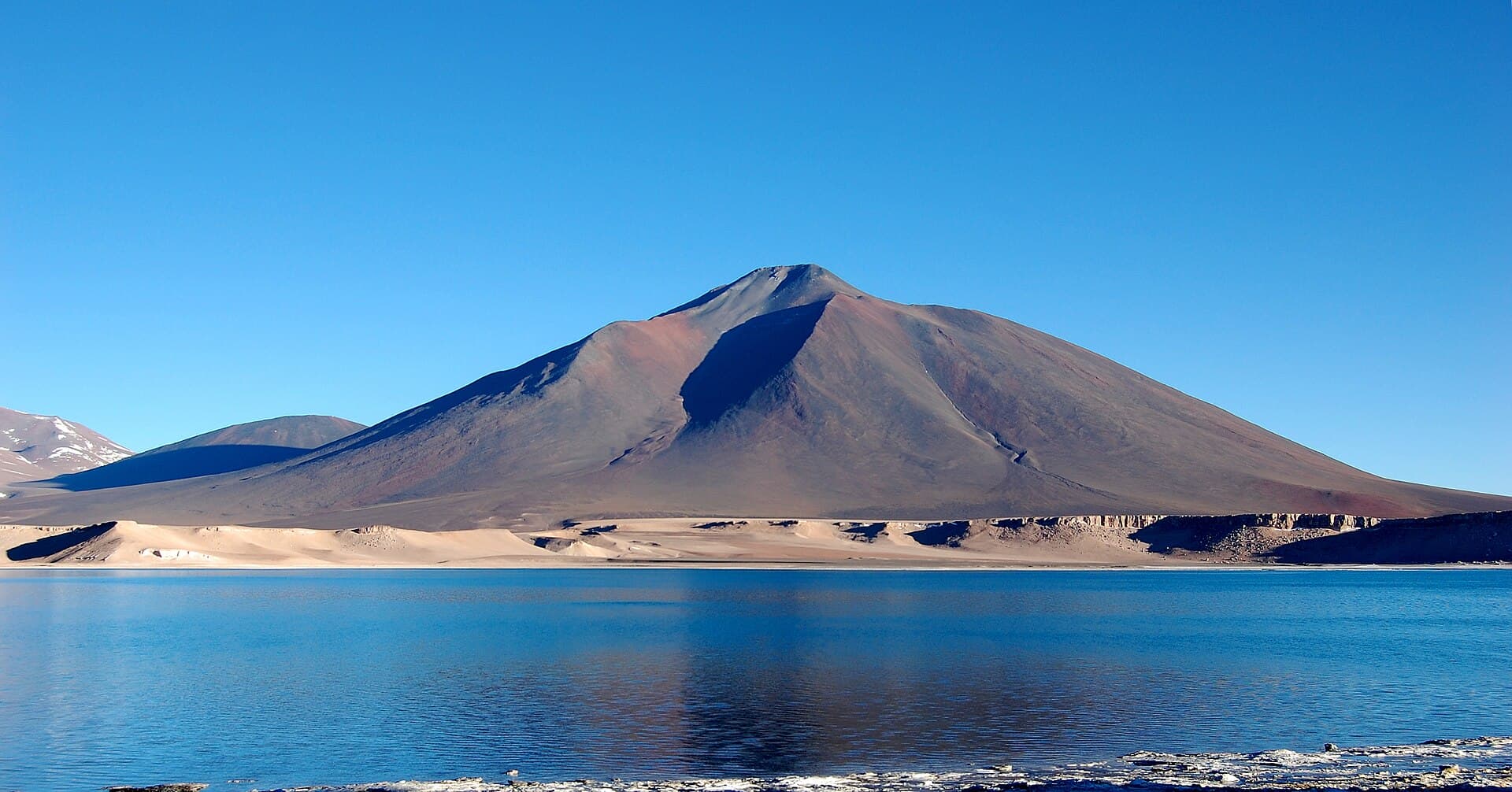
6,018 metres. No glacier, no crampons, no ice axe required. Vehicle access to ~5,000m. Cairns the entire way — "no possibility of getting lost." A local EPGAMT-certified guide for $830 all-in. This is arguably the most accessible 6,000-metre peak on Earth, and the best-value entry point to extreme altitude climbing.
Volcan San Francisco sits on the Argentina-Chile border at the Paso de San Francisco, the highest paved international road crossing in the Andes at 4,748m. The mountain rises directly above the border post. For climbers heading to Ojos del Salado or Monte Pissis, San Francisco doubles as an acclimatization peak — most Chilean-side Ojos itineraries schedule it on Day 5. For everyone else, it is a legitimate objective on its own.
The Numbers
| Metric | Data |
|---|---|
| Summit elevation | 6,018m (Andeshandbook; sources vary between 6,016m and 6,040m) |
| Starting elevation | 4,829m (from border crossing access track) |
| Elevation gain | +1,182m |
| Route distance (one-way) | 6.61km |
| Technical difficulty | Non-technical. No glacier, no crampons, no ice axe |
| Route marking | Cairns throughout |
| Round-trip time | 9-10 hours |
| First ascent | 1913 — Walther Penck (German geologist) |
| Permit cost | $0 |
| Guided cost (local EPGAMT) | ~$830 |
| Guided cost (international operator) | $3,932 |
Source: pakocrestas.wordpress.com — January 2026 report, Andes Vertical
Continue reading Monte Pissis — The Forgotten Second-Highest Volcano →
The Route
San Francisco is climbed as either a day trip from the Paso de San Francisco border area or a two-day outing with an overnight camp. The route starts from the border crossing access track at ~4,829m and ascends the volcanic cone directly.
Route Profile (January 2026 Data)
| Metric | Value |
|---|---|
| Starting point | Paso de San Francisco access track, 4,829m |
| Summit | 6,018m |
| Total gain | +1,182m |
| Distance (one-way) | 6.61km |
| Surface | Scree, volcanic rock, dirt |
| Navigation | Cairns throughout — straightforward in clear conditions |
| Technical gear needed | Semi-rigid boots. Nothing else mountaineering-specific |
| Time up | 5-6 hours |
| Time down | 3-4 hours |
The route is a hike. There is no glacier, no permanent snowfield in normal season, no exposed scrambling, and no route-finding challenge beyond following cairns. The difficulty is entirely physiological — gaining 1,200 vertical metres above 4,800m starting altitude in thin air.
Vehicle support: 4x4s can reach approximately 5,000m on summit day, shortening the approach for guided expeditions. On the Chilean-side Ojos del Salado itineraries, San Francisco is climbed directly from the Laguna Verde camp at 4,350m, adding elevation gain but providing better pre-acclimatization.
Source: pakocrestas.wordpress.com — January 2026
The 10-Day Guided Itinerary (with Acclimatization)
For climbers coming from low altitude, operators build a full acclimatization progression into the schedule.
| Day | Activity | Peak Elevation | Notes |
|---|---|---|---|
| 1 | Mendoza or Fiambala to Cortaderas | 3,200m | Drive, police registration |
| 2 | Fiambala to Cortaderas | 3,200m | Hotel night |
| 3 | Acclimatize: Cerro Coquena | 4,050m | Day hike |
| 4 | Transfer to Las Grutas base camp | 4,000m | 4x4 |
| 5 | Acclimatize: Cerro Falso Morocho | 4,500m | Day hike |
| 6 | Acclimatize: Volcan Bertrand | 5,270m | Longer day, altitude test |
| 7 | Rest / scenic day at Paso San Francisco | — | Recovery |
| 8 | Summit: Volcan San Francisco | 6,018m | 9-10hr round trip |
| 9 | Buffer day | — | Weather contingency |
| 10 | Return to Fiambala | — | Drive |
The acclimatization schedule takes climbers from 3,200m to 4,050m to 4,500m to 5,270m over four days before the summit push at 6,018m. This is a conservative, well-structured altitude progression. The summit day itself — starting from ~4,829m or higher — is manageable for any fit trekker who has properly acclimatized.
Inca Summit Structures
Two circle-shaped structures of Inca or Formative-period age sit on the summit of Volcan San Francisco. These are archaeological evidence that pre-Columbian people reached 6,018m without modern equipment — consistent with the Inca practice of building high-altitude ceremonial sites (capacocha) on the tallest peaks visible from administrative centres.
The most significant known Inca high-altitude site in the Puna is Llullaillaco (6,739m), approximately 300km to the north, where three remarkably preserved child mummies were uncovered in 1999. The San Francisco summit structures are modest by comparison but confirm the Inca ritual presence across the region's 6,000m peaks.
German geologist Walther Penck, who made the first European ascent in 1913, was likely the first outsider to document these ruins.
Source: Wikipedia — Nevado San Francisco, UCLA Cotsen Institute — Inca Rituals and Sacred Mountains
The Price Gap: $830 vs $3,932
This is the single most illustrative example of the international operator markup in high-altitude mountaineering.
| Option | Price (USD) | Days | What's Included |
|---|---|---|---|
| Local EPGAMT guide (via Explore-Share) | ~$830 (cash promo) | 9 | Guide, basic package, local transport |
| Andes Vertical (international operator) | $3,932 | 10 | Hotel in Fiambala, 4x4 transport, all meals, EPGAMT-certified guides |
| Various local guides | $800-1,500 | 7-9 | Variable |
The international operator charges 4.7x the local guide price for the same mountain. The Andes Vertical package includes more — hotel accommodation, all meals, logistics handled end-to-end. The local guide price assumes the climber handles their own accommodation and some transport.
The question is whether the logistical convenience and risk mitigation of the international operator are worth the 4.7x markup. For a first-time visitor to Catamarca province with no Spanish and no local contacts, $3,932 buys peace of mind. For a climber comfortable navigating Argentine infrastructure, $830 buys the same summit.
Either way, San Francisco at $830-3,932 for a 6,000m summit compares favourably to virtually any other 6,000m+ peak on Earth:
| Peak | Elevation | Typical guided cost | Permit |
|---|---|---|---|
| Volcan San Francisco | 6,018m | $830-3,932 | $0 |
| Aconcagua | 6,962m | $6,750-8,000+ | $1,170-1,640 |
| Denali | 6,190m | ~$8,000 | ~$400 |
| Island Peak (Nepal) | 6,189m | $1,500-3,000 | ~$400 |
| Stok Kangri (India) | 6,153m | $1,200-2,500 | Variable |
Source: Explore-Share — San Francisco Volcano, Andes Vertical
The "Gateway" Verdict
San Francisco is a legitimate 6,000m peak with real altitude exposure. The physiological challenge of reaching 6,018m is identical whether the route is technical or not — the same hypoxia, the same headache, the same leaden legs. The summit is higher than any point in Europe, Africa, or Oceania — though not North America, where Denali (6,190m) is higher, as the table above shows.
But the route is a hike. No mountaineering equipment required beyond semi-rigid boots. No glacier, no rope work, no exposure. For experienced trekkers who have done 5,000m+ peaks (Kilimanjaro, Thorong La, Kala Patthar), San Francisco is the natural next step.
As a standalone objective: A 6,000m summit on a volcano with Inca ruins, in the Puna de Atacama, for under $1,000. Legitimate.
As acclimatization for Ojos del Salado: Most Chilean-side operators include San Francisco on Day 5 of their itinerary. Reaching 6,018m before attempting 6,893m is a standard altitude progression — and if San Francisco goes badly, it is a clear signal to reconsider the Ojos attempt.
As a first 6K: Ideal. The non-technical route means the only variable is the climber's altitude response. If the body cooperates, the summit is assured. If it does not, the lesson is learned on a mountain with vehicle access to 5,000m and a relatively fast descent.
The $830 local guide price for this experience will not last as the Puna 6Ks gain international visibility. San Francisco is under-priced relative to its value.
What the Day Feels Like
Summit day on San Francisco starts before dawn. The 4x4 reaches ~4,829m or higher in darkness, headlamps illuminating the volcanic scree. The temperature at the start is typically -10 to -15C. As the sun rises over the Puna, the landscape reveals itself: brown volcanic slopes in every direction, the turquoise of distant salt lakes, and the Ruta de los Seismiles cutting a thin paved line through an ocean of 6,000m peaks.
The first hours are steady uphill on stable scree — tedious but not dangerous. Cairns mark the route at regular intervals. Above 5,500m, the altitude becomes the dominant reality: a headache that does not go away, legs that feel heavy, and lungs that never quite fill. The pace slows to 200-300 vertical metres per hour.
The summit plateau, if the Inca ruins are still visible, is a flat area of volcanic rubble with the two circular stone structures. Views extend to Ojos del Salado (6,893m) to the south, Tres Cruces (6,749m) to the west, and the vast Puna stretching north toward Llullaillaco. On a clear day, the horizon is 200+ kilometres away.
The descent is fast — 3-4 hours — but hard on the knees. Volcanic scree shifts underfoot. Most climbers are back at the vehicle by mid-afternoon, in time to soak at the Termas de Fiambala before dinner.
The Ruta de los Seismiles Context
Volcan San Francisco is one of nearly 20 peaks exceeding 6,000m along the Ruta de los Seismiles — the ~180km stretch of Ruta Nacional 60 from Fiambala to the Paso de San Francisco border crossing. This corridor has the second-highest density of extreme-altitude peaks on Earth after the Himalaya.
The route is fully paved and drivable as a scenic road trip even without climbing ambitions. But for mountaineers, San Francisco is the natural entry point to the corridor's collection of 6Ks. The progression from San Francisco (6,018m, non-technical) to Ojos del Salado (6,893m, PD scramble) to Monte Pissis (6,793m, full expedition) is a logical altitude ladder that builds skills and acclimatization at each step.
Source: La Ruta Natural, Chile Travel
Logistics
Getting to the Paso de San Francisco trailhead requires a vehicle. From Fiambala, it is approximately 180km via Ruta Nacional 60 — fully paved, 3-4 hours by car.
The Gendarmeria post at the Paso requires registration for border-zone access. No climbing permit is needed on the Argentine side.
For detailed transport information — flights, buses, 4x4 requirements, and the Paso de San Francisco border situation — see Getting to the Puna 6Ks.
For season and weather guidance, see When to Climb the Puna 6Ks.
The Elevation Question
Sources variously report San Francisco's height as 6,016m, 6,018m, 6,036m, and 6,040m. The Andeshandbook entry uses 6,018m. Wikipedia uses 6,016m. Some Argentine operators use 6,040m. The discrepancy reflects different survey methods and reference points.
For practical purposes, it does not matter. The mountain is above 6,000m by any measurement, and the climbing experience is identical regardless of which survey datum is cited.
Source: Wikipedia — Nevado San Francisco
10 Sources
- pakocrestas.wordpress.compakocrestas — January 2026 San Francisco expedition report (Tier 3)
- andes-vertical.comAndes Vertical — San Francisco Volcano Guided Ascent (Tier 3)
- explore-share.comExplore-Share — Expedition to San Francisco Volcano (Tier 3)
- en.wikipedia.orgWikipedia — Nevado San Francisco (Tier 2)
- madisonmountaineering.comMadison Mountaineering — Ojos del Salado (Tier 3)
- ioa.ucla.eduUCLA Cotsen Institute — Inca Rituals and Sacred Mountains (Tier 1)
- mountainplanet.comMountain Planet — Secrets of the Puna de Atacama (Tier 3)
- summitpost.orgSummitPost — Ojos del Salado (Tier 2)
- andes-vertical.comAndes Vertical — Aconcagua Fee Rates (Tier 3)
- larutanatural.gob.arLa Ruta Natural — Ruta de los Seismiles (Tier 2)