Ojos del Salado: The Complete Climbing Guide
6,893 metres. The highest volcano on Earth. The second-highest peak in the Western Hemisphere. Zero permit fees. Roughly one in three attempts reach the summit.
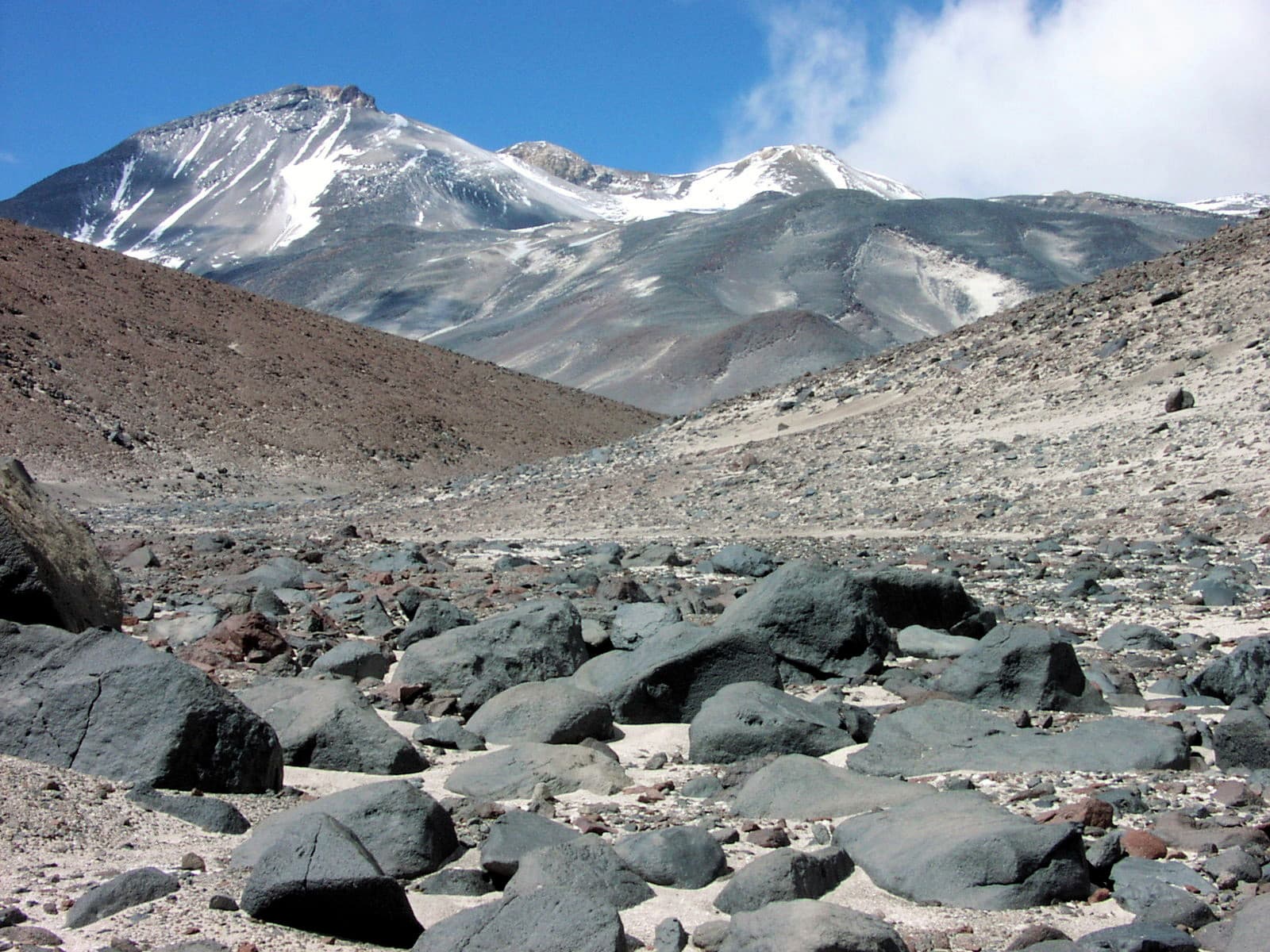
Ojos del Salado sits on the Argentina-Chile border in the Puna de Atacama — one of the driest, most desolate landscapes on the planet. The Atacama Desert receives less than 1mm of rainfall per year in places, making it 50 times drier than Death Valley. There are no tea houses, no porters, no crowds. The beauty is geological and alien — penitentes, salt flats, flamingos in turquoise lagoons at 4,000m, and a summit crater lake at 6,490m that has no business existing in the driest desert on Earth.
This is not Aconcagua-lite. It is a different paradigm entirely.
The Numbers
| Metric | Data |
|---|---|
| Summit elevation | 6,893m (Chilean survey, most cited figure) |
| Rank | Highest volcano on Earth. 2nd-highest peak in the Western Hemisphere |
| First ascent | February 26, 1937 — Jan Alfred Szczepanski and Justyn Wojsznis (Polish) |
| Technical grade | F to PD (Alpine); YDS 5.6 scramble at 6,850m |
| Summit success rate | ~33% of attempts |
| Annual climbers | ~600 attempts per year |
| Climbing season | November to March |
| Permit cost (Argentine) | $0 |
| Permit cost (Chilean DIFROL) | $0 — free, apply 20+ business days in advance |
| Guided expedition cost | $2,500-8,950 depending on operator |
Source: Wikipedia, Explore-Share, GuidedPeaks
Continue reading Monte Pissis — The Forgotten Second-Highest Volcano →
Route 1: Chilean Ruta Normal (via Laguna Verde)
The most popular route. Established refugios, 4x4 road access to 5,800m, and a shorter overall approach. Duration: 9-15 days depending on acclimatization profile.
Stage-by-Stage Breakdown
| Day | Stage | From / To | Elevation | Notes |
|---|---|---|---|---|
| 1 | Transfer | Copiapo to El Salvador | 2,600m | Briefing, gear check |
| 2 | Acclimatization | El Salvador to Pedernales Salt Flat | 3,362m | 90km drive, evening walk |
| 3 | Acclimatize | Climb Cerro Dona Ines | 5,070m | 5-6hrs round trip |
| 4 | Transfer | Drive to Laguna Verde via customs | 4,350m | Camp at hot springs |
| 5 | Acclimatize | Climb Volcan San Francisco | 6,018m | 6-8hrs. A standalone objective — see the San Francisco guide |
| 6 | Rest | Laguna Verde | 4,350m | Weather contingency |
| 7 | Transfer | Drive to Refugio Atacama | 5,255m | Off-road, 4x4 mandatory |
| 8 | Carry | Atacama to Refugio Tejos and back | 5,825m | Cache gear, sleep low |
| 9 | Move | Atacama to Refugio Tejos | 5,825m | Establish high camp |
| 10 | Summit | Tejos to Summit to Tejos | 6,893m | Alpine start 3-5AM, 8-9hrs up |
| 11 | Descend | Break camp, drive to Copiapo | — | 6hr drive |
Source: Madison Mountaineering
The Chilean Refugios
| Refugio | Elevation | Beds | Condition | Notes |
|---|---|---|---|---|
| Refugio Claudio Lucero (Murray) | ~4,500m | Basic | Variable | Near road start, car-accessible |
| Refugio Atacama / U. de Atacama | 5,200-5,255m | ~8 | Basic | Kitchen, common area |
| Refugio Tejos | 5,825m | 6 bunks | Spartan | Two shipping containers. Kitchen + beds. Very cold — no ground insulation. Solar-powered emergency radio |
| Rescue Hut | 6,100m | Emergency only | — | Highest rescue hut on Earth |
Refugio Tejos is two converted shipping containers bolted to a scree slope at 5,825m. Six bunks, a rudimentary kitchen, and temperatures that drop well below -20C at night. There is no ground insulation — sleeping directly on the metal floor without a thick pad is a recipe for hypothermia. The solar-powered emergency radio may or may not work depending on season and maintenance. Plan to be self-sufficient.
Water on the Chilean route: Snowfields near Tejos provide meltwater in the afternoon, but supply is season-dependent. Below Refugio Atacama, there is no reliable water without carrying from the Laguna Verde area.
Source: countryhighpoints.com, Explore-Share
Route 2: Argentine Route (Cazadero Grande / Ruta Varsoviana)
Longer, more remote, more scenic. No refugios. No drivable road to base camp. Running water at lower camps but a 14km waterless stretch in the middle section. Duration: 13-15 days from Fiambala.
Stage-by-Stage Breakdown
| Stage | Camp | Elevation | Notes |
|---|---|---|---|
| Trailhead | Cazadero Grande / Refugio Quemadito | ~3,800m | 10km by 4x4 from Ruta 60, 113km from Fiambala |
| Camp 1 | El Chorro / Tamberias | ~4,000m | Valley walking, river follows route |
| Camp 2 | Aguas Calientes | ~4,200m | Last reliable water source — Cazadores River |
| Camp 3 | Aguas de Vicunas | ~4,950m | 7hrs from previous camp |
| Base Camp | El Arenal | 5,400-5,500m | Plateau below the mountain. 7hrs from Aguas de Vicunas |
| High Camp | Below summit | ~6,000m | Exposed, no shelter |
| Summit | Ojos del Salado | 6,893m | Same final section as Chilean route |
The Argentine approach is 43km from Quemadito to high camp. No refugios. All camping. Mule support is available to base camp. At least one experienced operator states that published route maps for the Argentine side are "purely made by fantasy and absolutely wrong" — navigation must be done by precise GPS coordinates, not cartography.
Source: thecloudocean.com, AlexClimb, andes.org.uk
The Summit: Trek With a Climb at the End
The reality: Ojos del Salado is a trek until it is not. From either side, the route is non-technical hiking over scree and sand until the final approach to the summit crater. Then three things happen in quick succession:
- 100m of 35-degree snow slope below the crater rim. Crampons required in season.
- A chimney pitch at ~6,850m — approximately 30m of rock scrambling graded YDS 5.6 (UIAA IV) at altitude. Fixed ropes are present on the Chilean route in three sections. Helmet mandatory. The crux is exposed and wind-blasted.
- The descent involves down-climbing the 4th-class crux with self-belay, then plunging down the couloir.
At sea level, 5.6 is trivial — comfortable for any gym climber. At 6,850m with -25C and 80km/h winds, it becomes a serious mountaineering problem. Thick gloves, numb fingers, and an oxygen-starved brain make every move deliberate. This is where most turnarounds happen.
Alpine grade: F to PD (Facile to Peu Difficile). Calling this a "walk-up" is irresponsible.
Gear required for summit day: Harness, helmet, ice axe, crampons, rope (for guide teams), headlamp.
Source: GuidedPeaks, Explore-Share, andes.org.uk
The Crater Lake at 6,490m
Inside the summit crater sits the highest lake on Earth — approximately 100m in diameter, covering ~6,000 square metres, fed by permafrost and snowfields. A creek feeding the lake reaches 40.8C, heated by geothermal activity from the volcano itself. The lake is surrounded by active fumaroles emitting sulfur.
This is a scientific anomaly: standing water at the boundary of the troposphere, in the driest non-polar desert on Earth. The volcano is not extinct — the Smithsonian Global Volcanism Program classifies Ojos del Salado as active based on persistent fumarolic activity, with the last confirmed eruption around 750 CE. In November 1993, observers at a police post 30km from the summit witnessed an intermittent gray column of water vapor and solfataric gases for three hours.
Source: Wikipedia, Smithsonian GVP
Why Only 1 in 3 Summits Succeed
The roughly 33% success rate is driven by three factors:
Altitude. At 6,893m, atmospheric pressure is roughly 45% of sea level. Every step above 6,500m is a negotiation with physiology. Acute mountain sickness, pulmonary edema, and cerebral edema are the primary turn-around triggers. Proper acclimatization takes 10-14 days minimum.
Wind. The Puna de Atacama is defined by relentless wind. At summit level, gusts regularly exceed 80km/h, with mountain-forecast.com documenting gusts up to 200km/h during the climbing season. Wind chill drives effective temperatures to -30C or lower. Tents at high camp are damaged regularly.
The summit chimney. The YDS 5.6 scramble at 6,850m is the technical crux. Climbers who are strong at altitude but have no rock scrambling experience turn around here. Climbers who can scramble but are impaired by altitude turn around here. Both skills must coincide on the same day, in tolerable wind, with sufficient daylight remaining.
A March 2025 expedition by Andes Specialists sent 15 climbers — 6 summited (40%). Several non-summiters reached 6,000-6,100m before turning back. This is consistent with the historical average.
Source: Wikipedia, Explore-Share, Andes Specialists March 2025 report
Permits and Red Tape
Argentine Side (Catamarca Province)
| Requirement | Status | Cost |
|---|---|---|
| Provincial climbing permit | Not required | $0 |
| Registration with tourist police (Fiambala) | Recommended/expected | Free |
| Registration with Gendarmeria (La Gruta) | Required for border zone access | Free |
| Mandatory guide | Not required | — |
Catamarca has no permit system, no fee structure, and no quota system equivalent to Mendoza's Aconcagua park. Nobody is formally tracking who goes up and when. This is a cost advantage and a safety gap.
Chilean Side (DIFROL + CONAF)
| Requirement | Status | Cost |
|---|---|---|
| DIFROL climbing permit | Mandatory for non-Chilean climbers | Free — apply at difrol.cl, 20+ business days in advance |
| CONAF park entry (Nevado Tres Cruces) | Required if transiting park | ~$180 (reported, varies) |
| Carabineros checkpoint (Laguna Verde) | Present DIFROL permit + fill climbing form | Free |
| Equipment list | Must submit to authorities | — |
The official climbing season runs November 1 through March 31. Expeditions outside these dates require a special permit.
Source: SummitPost, GuidedPeaks, DIFROL
What It Costs
Guided Expedition Comparison (2026 Season)
| Operator | Price (USD) | Days | Route | Notes |
|---|---|---|---|---|
| High Mountain LA | ~$2,500-3,500 | 6-14 | Chilean | 80+ expeditions. Express option available |
| Andes Specialists | $3,980 (group) | 14 | Chilean | Starlink, gourmet chef, 1:2.5 ratio |
| Chile Montana | $4,200 | 13 | Chilean | UIAGM guides, DIFROL included |
| SummitClimb | $4,350 | 14 | Chilean | Leader has 40+ Ojos expeditions |
| Andes Vertical | $4,790-4,900 | 14 | Argentine | EPGAMT-certified, bilingual, includes 4x4 + mules |
| Alpenglow Expeditions | $8,950 | 9 | Chilean | "Rapid Ascent" — requires 28 days of altitude tent training at home |
| Madison Mountaineering | $9,850 | 12 | Chilean | Premium |
The spread is $2,500 to $9,850 for the same mountain. The Alpenglow premium compresses the trip from 14 to 9 days by requiring pre-acclimatization with a Hypoxico tent system (~$200-400/month rental). For high-earning professionals, the time savings may justify the cost.
Independent Budget (Argentine side, experienced mountaineer)
| Category | Cost |
|---|---|
| Domestic flight (BUE to Catamarca, return) | $300-420 |
| Transport Catamarca to Fiambala | $23-60 |
| 4x4 to trailhead | ~$100-200 |
| Food and fuel (14 days) | $300-500 |
| Insurance (7,000m rated) | $200-400 |
| Total | $1,200-2,000 |
This budget requires owning all high-altitude gear and having extensive self-supported expedition experience. The Argentine route has no refugios, no drivable road to base camp, and inaccurate published maps.
Source: Andes Specialists, Madison Mountaineering, Alpenglow, Andes Vertical
The Aconcagua Comparison
| Aconcagua | Ojos del Salado (Chilean) | |
|---|---|---|
| Summit elevation | 6,962m | 6,893m (68m less) |
| Permit (foreign climber) | $1,170-1,640 | $0 |
| Mid-range guided | ~$6,750 | ~$3,980-4,200 |
| Total cost (mid-range guided, all-in) | ~$9,500 | ~$5,000 |
| Annual climbers | 3,500-4,000 | ~600 |
| Rescue infrastructure | Military helicopter, park rangers | None (Argentine side). CONAF station only (Chilean) |
| Evacuation to hospital | 2-4 hours | 8-14+ hours |
Ojos del Salado costs roughly 50-55% of Aconcagua for comparable guided service — not the "1/5 the cost" that some articles claim. The real savings come from zero permit fees and lower operator prices. The real trade-off is in rescue infrastructure and remoteness.
See Getting to the Puna 6Ks for detailed transport logistics and When to Climb for the weather window breakdown.
Source: Andes Vertical Aconcagua fee schedule, Skyhook — Aconcagua cost
Rescue Reality
If something goes wrong above 5,000m on the Argentine side, the evacuation path is:
- Carry or walk the patient down to base camp (4,600m) — multiple hours
- 4x4 drive 5-7 hours over rough terrain to Fiambala
- Emergency treatment at Fiambala's Hospital Interzonal "Luis Agote" (inaugurated 2023, Level 1 hospital, limited capacity)
- If needed, 4.5-hour ambulance transfer to Catamarca capital (320km)
Best case: 12+ hours from incident to hospital. On Aconcagua, that scenario gets helicopter evacuation within 2-4 hours in good weather.
No dedicated mountain rescue helicopter exists in Catamarca Province. A helicopter emergency evacuation would need to be organized through Catamarca capital or potentially Copiapo (Chile). Without Global Rescue membership or equivalent, a helicopter evacuation could exceed $100,000.
Satellite phone or InReach is mandatory for independent parties. Cell coverage is zero above Fiambala on the Argentine side and beyond Copiapo on the Chilean side.
Source: Global Rescue, elesquiu.com
The Vehicle Record
In 2015, a modified car reached 6,688m on Ojos del Salado — the highest a car has ever driven on Earth. On the Chilean side, 4x4s routinely reach 5,900m on the dirt road to Refugio Tejos. This is not a remote wilderness summit in the traditional sense — the Chilean approach can deliver a vehicle to within ~1,000 vertical metres of the top.
The Argentine side is different. Vehicles go as far as Refugio Quemaditos (~3,800m), and from there it is foot or horse travel for the remaining 43km.
The First Ascent: A Polish Story
The Second Polish Andean Expedition (1936-1937), led by journalist Justyn Wojsznis, reached the summit on February 26, 1937. Jan Alfred Szczepanski and Wojsznis left a cairn. They had spent days ascending the Rio Salado ("Salty River"), for which the mountain was believed to be the source — hence the name, which translates roughly as "Eyes/Sources of the Salty River." The Polish climbers also observed sulfurous fumaroles 200 metres below the summit — the first recorded documentation of the volcano's ongoing activity.
Most of the expedition's maps and reports were lost during World War II, creating a documentation gap that fuelled controversy for decades. Later Austrian climbers found the Polish cairn was not at the exact summit — it may have been on a subsidiary point. The Andean Club of Chile ultimately confirmed the 1937 Polish expedition as the first ascent.
Source: 1930s Polish Andean expeditions — Wikipedia, AAC Publications
14 Sources
- en.wikipedia.orgWikipedia — Ojos del Salado (Tier 2)
- volcano.si.eduSmithsonian Global Volcanism Program — Nevados Ojos del Salado (Tier 1)
- guidedpeaks.comGuidedPeaks — Ojos del Salado Complete Guide (Tier 3)
- explore-share.comExplore-Share — Ojos del Salado Facts (Tier 3)
- summitpost.orgSummitPost — Ojos del Salado (Tier 2)
- madisonmountaineering.comMadison Mountaineering — Ojos del Salado (Tier 3)
- andes-specialists.comAndes Specialists — Ojos del Salado Expedition (Tier 3)
- andes-vertical.comAndes Vertical — Ojos del Salado Guided Expedition (Tier 3)
- alpenglowexpeditions.comAlpenglow Expeditions — Rapid Ascent (Tier 3)
- countryhighpoints.comcountryhighpoints.com — Chile Ojos del Salado (Tier 3)
- andes.org.ukandes.org.uk — Ojos del Salado (Tier 3)
- alexclimb.comAlexClimb — Climbing Ojos del Salado from Argentina 2023 (Tier 3)
- en.wikipedia.org1930s Polish Andean Expeditions — Wikipedia (Tier 2)
- globalrescue.comGlobal Rescue — Medevac Rescue (Tier 2)