Monte Pissis: The Forgotten Second-Highest Volcano
6,793 metres. Entirely within Argentina. No refugios, no huts, no fixed ropes, no rescue. The second-highest volcano on Earth went 48 years between its first and second ascent — not because it was technically difficult, but because nobody could get to it.
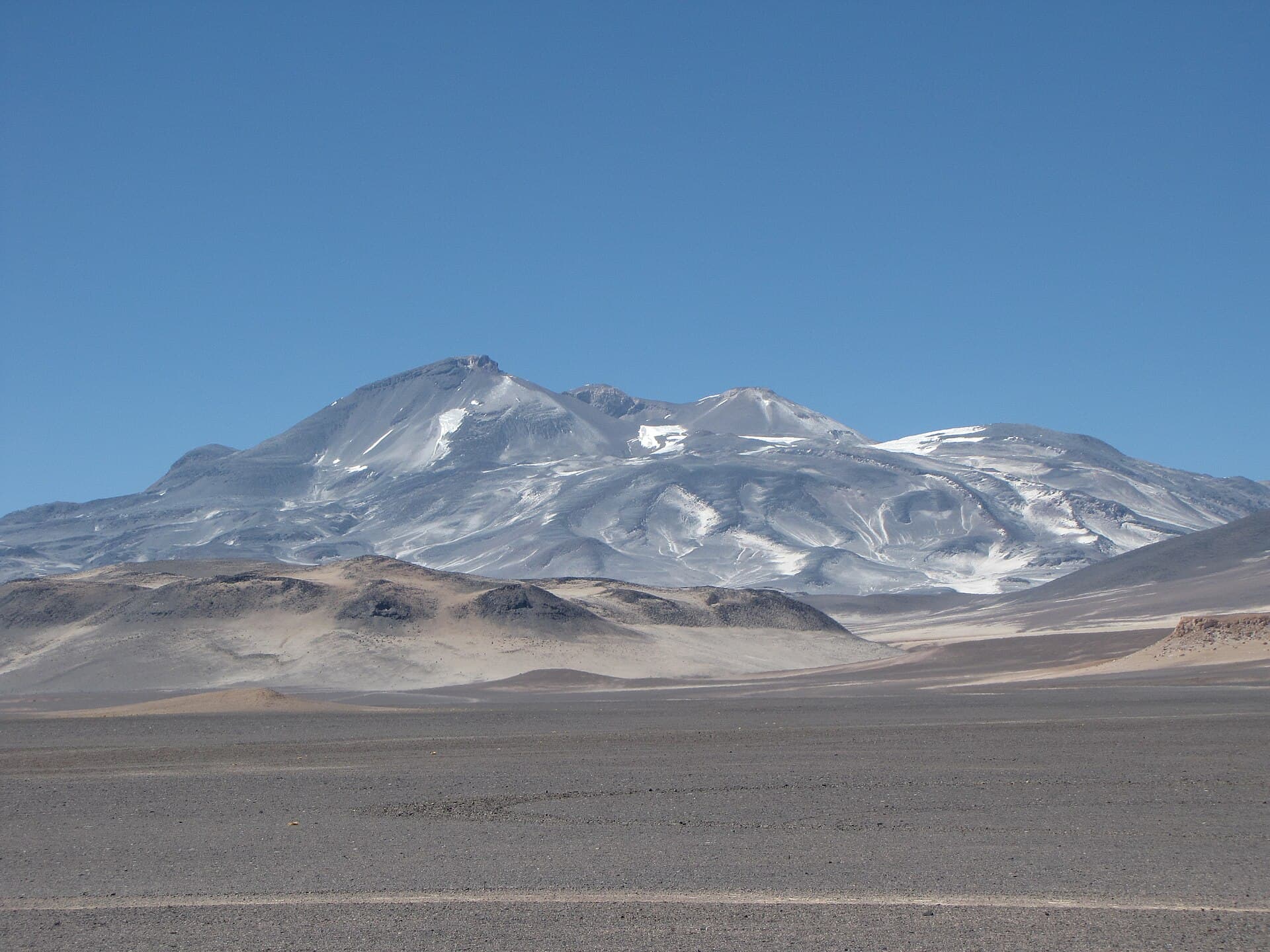
Monte Pissis sits on the Catamarca-La Rioja border in the Puna de Atacama, roughly 100km south of Ojos del Salado. The third-highest peak in the Western Hemisphere after Aconcagua and Ojos, it sees perhaps a few dozen climbers per year. Only four operators worldwide run guided expeditions to its summit.
This is genuine expedition mountaineering. The kind that existed before permits, huts, and GPS tracks made high-altitude climbing a logistics exercise.
The Numbers
| Metric | Data |
|---|---|
| Summit elevation | 6,793m (2005 DGPS survey) |
| Rank | 2nd-highest volcano on Earth. 3rd-highest peak in the Western Hemisphere |
| First ascent | February 7, 1937 — Stefan Osiecki and Jan Alfred Szczepanski (Polish) |
| Second ascent | 1985 — 48 years later |
| Technical grade | F (Alpine Grade 1). Non-technical but crampons needed for glacier |
| Guided expedition cost | $4,200 (Andes Vertical, 14 days) |
| Permit cost | $0 — no permit system exists |
| Annual climbers | A few dozen, estimated |
| Nearest hospital | Fiambala, 5-7 hours by 4x4 |
Source: Wikipedia, Andes Vertical
Continue reading Volcan San Francisco — The Gateway 6K for $830 →
The 48-Year Gap
The Second Polish Andean Expedition reached the summit of Monte Pissis on February 7, 1937 — Stefan Osiecki and Jan Alfred Szczepanski, the same team that would summit Ojos del Salado nineteen days later. The mountain was then left alone for nearly half a century.
The second ascent did not happen until 1985, after mining roads penetrated the remote Puna landscape enough to make a 4x4 approach feasible. That gap tells the story more clearly than any route description: Pissis was not unclimbable. It was unreachable.
Most of the Polish expedition's records were lost during World War II. The elevation they recorded (5,950m) was massively wrong — a reflection of the barometric technology available in 1937.
Source: Wikipedia, 1930s Polish Andean expeditions — Wikipedia
The Altitude Controversy
For over a decade, Monte Pissis threatened to dethrone Ojos del Salado as the world's highest volcano.
In 1994, an Argentine GPS expedition measured Pissis at 6,882m — which would have made it taller than Ojos del Salado's commonly cited 6,880-6,893m figure. The claim circulated widely in mountaineering literature.
In 2005, an Austrian expedition using high-precision Differential GPS (DGPS) re-surveyed the mountain and found it to be 6,793m — a correction of nearly 90 metres downward. A follow-up 2007 joint Chilean-Argentine-European survey confirmed: Ojos del Salado at 6,891m, Monte Pissis at 6,793m. A gap of 98 metres, definitively settling the debate.
The lesson: GPS accuracy in the 1990s was not what it is today. A 90-metre error at extreme altitude, in a remote location with limited reference points, was entirely plausible.
Source: Wikipedia, viewfinderpanoramas.org — Summit Elevation Errors
The Route: 14-Day Expedition from Fiambala
The standard route approaches from the Argentine side via Cortaderas and Laguna Los Aparejos.
Stage-by-Stage Breakdown
| Day | Stage | From / To | Elevation | Notes |
|---|---|---|---|---|
| 1 | Transfer | La Rioja or Fiambala to Cortaderas | 3,300m | Hotel night |
| 2 | Acclimatize | Cortaderas to Las Losas | 3,710m | Hike to Monte Naranja (3,863m) |
| 3 | Acclimatize | Las Losas to La Gruta | 4,088m | Climb Falso Morocho |
| 4 | Acclimatize | La Gruta to Paso San Francisco | 4,727m | Hike |
| 5 | Transfer | Paso San Francisco to Laguna Los Aparejos | 4,190m | 4x4 |
| 6 | Transfer | Los Aparejos to Base Camp | 4,600m | 4x4 |
| 7 | Portage | Base Camp to Camp 1 and back | 5,360m | Carry loads, sleep low |
| 8 | Move | Base Camp to Camp 1 | 5,360m | Overnight |
| 9 | Rest | Camp 1 | 5,360m | Acclimatize |
| 10 | Move | Camp 1 to Camp 2 | 5,900m | Glacier edge |
| 11 | Summit | Camp 2 to Summit to Camp 2 | 6,793m | 6.37km, +1,469m elevation gain |
| 12 | Descend | Camp 2 to Base Camp to Cortaderas | — | Long day |
| 13 | Contingency | Weather day | — | — |
| 14 | Exit | Cortaderas to Fiambala or airport | — | — |
Route Description (January 2026 Expedition Data)
From base camp, the route traverses a long, gently ascending plateau westward. Climbers cross a penitentes field, ascend the rocky slope on the glacier's right margin, traverse obliquely toward a red promontory, cross the high caldera crater heading south, then reach the summit ridge.
Total base-to-summit: 12.71km, +2,187m vertical gain.
Source: pakocrestas.wordpress.com — January 2026 expedition report
Why Pissis Is Harder Than Ojos (Despite Being 100m Lower)
The technical grade is lower — Alpine F (non-technical) versus Ojos del Salado's PD. No summit chimney, no fixed ropes, no 5.6 scramble. On paper, Pissis should be the easier mountain. In practice, it is not.
Zero fixed infrastructure. No refugios, no huts, no rescue hut, no fixed ropes. Everything is carried in, everything is carried out. The Chilean side of Ojos del Salado has three refugios and a drivable road to 5,800m. Pissis has nothing.
Remoteness. The 4x4 transfer from Fiambala involves river fording and roads that are not marked on any map. One operator describes it as "14 hours of travel with no trail to follow." The approach to base camp alone takes multiple days.
No rescue. The nearest hospital is Fiambala's Level 1 facility, 5-7 hours away by 4x4 over rough terrain. No dedicated mountain rescue exists in Catamarca Province. No helicopter service. If something goes wrong at Camp 2 (5,900m), the best-case evacuation to a hospital is 12+ hours.
Glacier. Despite sitting in the driest desert on Earth, Pissis has a glacier starting at approximately 5,900m. Crampons are recommended above Camp 2. The glacier is a unique feature for the Puna de Atacama.
Fewer climbers. Far fewer annual attempts than Ojos means less route-finding assistance, less packed trail, and less help if something goes wrong. On any given summit day, a team on Pissis may be the only people on the mountain.
Source: Explore-Share, Wikipedia
Water
A clean stream at the Camp 1 platform (5,360m) flows year-round. This is the last reliable water source. Above 5,360m, the only option is melting penitentes — the sun-sculpted ice pinnacles that form across the glacier surface. Carry a stove and fuel for all water above Camp 1.
Source: pakocrestas.wordpress.com — January 2026 report
What It Costs
| Operator | Price (USD) | Days | Notes |
|---|---|---|---|
| Andes Vertical | $4,200 | 14 | Only 1 departure listed (March 2026). EPGAMT-certified guides |
| GuidedPeaks listings | ~$4,000-5,000 | 14 | Only 4 guides worldwide offer Pissis |
| Argentina Extrema | $1,950 | — | Budget operator |
The guided price is comparable to Ojos del Salado ($3,980-4,900), but independent attempts are more expensive due to the total self-sufficiency required and the logistical complexity of reaching base camp.
The market reality: Monte Pissis has almost no commercial infrastructure. Only a handful of operators worldwide run this peak. Departure dates are limited — often just one or two per season. If the dates do not work, private rates apply.
Source: Andes Vertical, GuidedPeaks
Who Climbs Pissis
Two groups: volcano completionists targeting the Volcanic Seven Summits (the highest volcano on each continent), and "Second Seven Summits" climbers pursuing the second-highest peak on each continent. For both groups, Pissis is a necessary stop.
Beyond the collector crowds, Pissis draws climbers seeking the expedition experience that Ojos del Salado (especially from the Chilean side) increasingly does not provide. One operator describes the Argentine Puna as offering "the purity and pristine mountains, close contact with harsh wildlife, the absence of crowds and excessive commercial activity."
For collectors: Pissis is a genuine wilderness high-altitude experience at near-7,000m. For everyone else: Ojos del Salado or Volcan San Francisco are more accessible starting points.
Source: AlexClimb, ExplorerSweb
The Landscape: Mars With a Glacier
Pissis occupies the Puna de Atacama — the driest non-polar desert on Earth. The approach to base camp crosses salt flats, penitentes fields (sun-sculpted ice pinnacles that look like frozen white flames), and volcanic terrain devoid of vegetation. There is no wildlife above 4,500m. No birdsong, no insects, no running water except for the stream at Camp 1. The silence is total.
The colours are geological: ochre, rust, grey-black volcanic rock, white salt, and the occasional turquoise of a mineral-loaded lagoon. The Puna has been compared to Mars by NASA, which uses the Atacama as an analogue for Martian soil research. Climbers who expect alpine beauty will be disappointed. Climbers who find emptiness compelling will find Pissis unforgettable.
The glacier itself — starting at approximately 5,900m — is an anomaly. A permanent ice body in the driest desert on Earth, surviving because the extreme altitude keeps temperatures below freezing year-round. Climate change is almost certainly altering its extent, but no recent satellite survey has been published to quantify the change.
Weather and Timing
The climbing season is November to March, matching the rest of the Puna 6Ks. The same invierno boliviano (Bolivian winter) risk that affects Ojos del Salado applies to Pissis: Amazon basin moisture pushes south in January and February, bringing sudden storms and whiteouts to the high Puna. December and March offer more stable conditions.
On summit day, the 12.71km traverse from base camp requires a weather window of 12+ sustained hours. A storm that rolls in during the high-caldera crossing — at 6,500m+ with no shelter — is a survival situation, not a delay.
For the full month-by-month breakdown, see When to Climb the Puna 6Ks.
The Rescue Reality
This section exists because it should. The evacuation scenario from Camp 2 (5,900m):
- Carry or walk the patient down to base camp (4,600m) — minimum several hours, likely half a day
- 4x4 drive 5-7 hours over rough terrain with river fording to Cortaderas or Fiambala
- Emergency treatment at Fiambala's Hospital Interzonal "Luis Agote" (Level 1, limited capacity — 10 beds, basic operating room)
- If complex care is needed, 4.5-hour ambulance transfer to San Fernando del Valle de Catamarca (320km)
Best case: 12+ hours from incident to hospital. Worst case: significantly longer. No dedicated mountain rescue helicopter exists in Catamarca Province. A satellite phone or InReach beacon is not optional — it is mandatory.
Insurance must explicitly cover high-altitude mountaineering to 7,000m and helicopter evacuation in remote areas. Without Global Rescue membership or equivalent, an emergency evacuation could exceed $100,000.
Source: Global Rescue, elesquiu.com — Fiambala hospital
10 Sources
- en.wikipedia.orgWikipedia — Monte Pissis (Tier 2)
- en.wikipedia.org1930s Polish Andean Expeditions — Wikipedia (Tier 2)
- andes-vertical.comAndes Vertical — Monte Pissis Guided Expedition (Tier 3)
- guidedpeaks.comGuidedPeaks — Monte Pissis (Tier 3)
- explore-share.comExplore-Share — Monte Pissis 14-day expedition (Tier 3)
- pakocrestas.wordpress.compakocrestas — January 2026 Pissis expedition report (Tier 3)
- viewfinderpanoramas.orgviewfinderpanoramas.org — Summit Elevation Errors (Tier 2)
- alexclimb.comAlexClimb — Climbing Ojos del Salado from Argentina 2023 (Tier 3)
- globalrescue.comGlobal Rescue — Medevac Helicopters (Tier 2)
- explorersweb.comExplorerSweb — Second Seven Summits (Tier 3)