
When to Climb the Puna 6Ks
The climbing season is November to March. Most operator websites say "December to February is best." Most of them are wrong — or at least dangerously incomplete.
The Puna de Atacama has a season-killer that almost no English-language trekking content mentions: the invierno boliviano (Bolivian winter, also called the invierno altiplanico). It is the single most important weather factor for climbers targeting Ojos del Salado, Monte Pissis, or Volcan San Francisco, and it peaks in January and February — the months most agencies market as "best."
The Invierno Boliviano
Between December and March, moisture from the Amazon basin pushes south across Bolivia and into the Puna de Atacama. This phenomenon — the South American monsoon's southern edge — brings sudden thunderstorms, heavy snowfall, and whiteout conditions to a region that normally receives almost no precipitation.
The effect is strongest in January and February. During an invierno boliviano event, a cloudless morning can deteriorate into a full whiteout by mid-afternoon. Snow accumulates rapidly at altitude. Wind combines with precipitation to create dangerous conditions above 6,000m.
The invierno boliviano does not happen every day in January-February. Some seasons, it barely materialises. Other seasons, it delivers multi-day storm cycles that shut down all climbing activity. The problem is unpredictability — it cannot be forecast more than a few days in advance, and when it arrives, there is no shelter above Refugio Tejos (5,825m) on the Chilean side or anywhere on the Argentine side.
This is why operator-marketed "peak season" in January-February carries a risk that December and March do not.
Source: SummitPost, Wikipedia, AllMountain Chile
Continue reading The World's Most Accessible Extreme Altitude — Catamarca's Puna 6Ks in 2026 →
Month-by-Month Breakdown
| Month | Temperature (summit zone) | Weather | Crowds | Verdict |
|---|---|---|---|---|
| June-September | -30C or lower | Bitter cold, heavy snow, road closures | Mountain closed | Closed. Paso de San Francisco impassable. No operator runs expeditions |
| October | -25 to -30C | Cold, possible late-season snow | Rare | Marginal. Some early expeditions by experienced teams. Cold nights, snow from winter may linger above 6,000m |
| November | -20 to -25C | Opening. Colder than Dec-Feb but more stable wind patterns | Low | Viable for experienced climbers. Season officially opens Nov 1 (DIFROL). Fewer climbers, colder but stable |
| December | -15 to -25C | Warming. Pre-invierno-boliviano stability. Clear skies dominant | Moderate | Best overall window. Warmest daytime temps building. Amazon moisture has not yet reached the Puna. Most operators begin departures |
| January | -15 to -25C | Warmest daytime temps. Invierno boliviano risk — thunderstorms, sudden snow, whiteouts from Amazon moisture | Peak | Risky. Peak season for operators and climbers. Best daytime temperatures, but mid-month storms from the invierno boliviano can shut down the mountain for days |
| February | -15 to -25C | Still warm. Peak invierno boliviano risk — same storms as January, sometimes worse | High | Risky. Storm risk continues. Wind increasing toward month's end |
| March | -20 to -25C | Storms subside. Warm. Fewer climbers | Moderate | Second best window. Amazon moisture retreats north. Stable weather returns. Days getting shorter, nights cooling. Last reliable window |
| April | -25 to -30C | Unpredictable. Some warm calm spells, some early winter events | Very low | Gamble. Some operators still run until mid-April. Short days, cold nights, increasing closure risk |
| May | -30C or lower | Winter approaching | Mountain closed | Closed. Season ending. Paso closures become routine |
Source: Andes Vertical, SummitPost — Puna de Atacama, Explore-Share
Temperature and Wind at Altitude
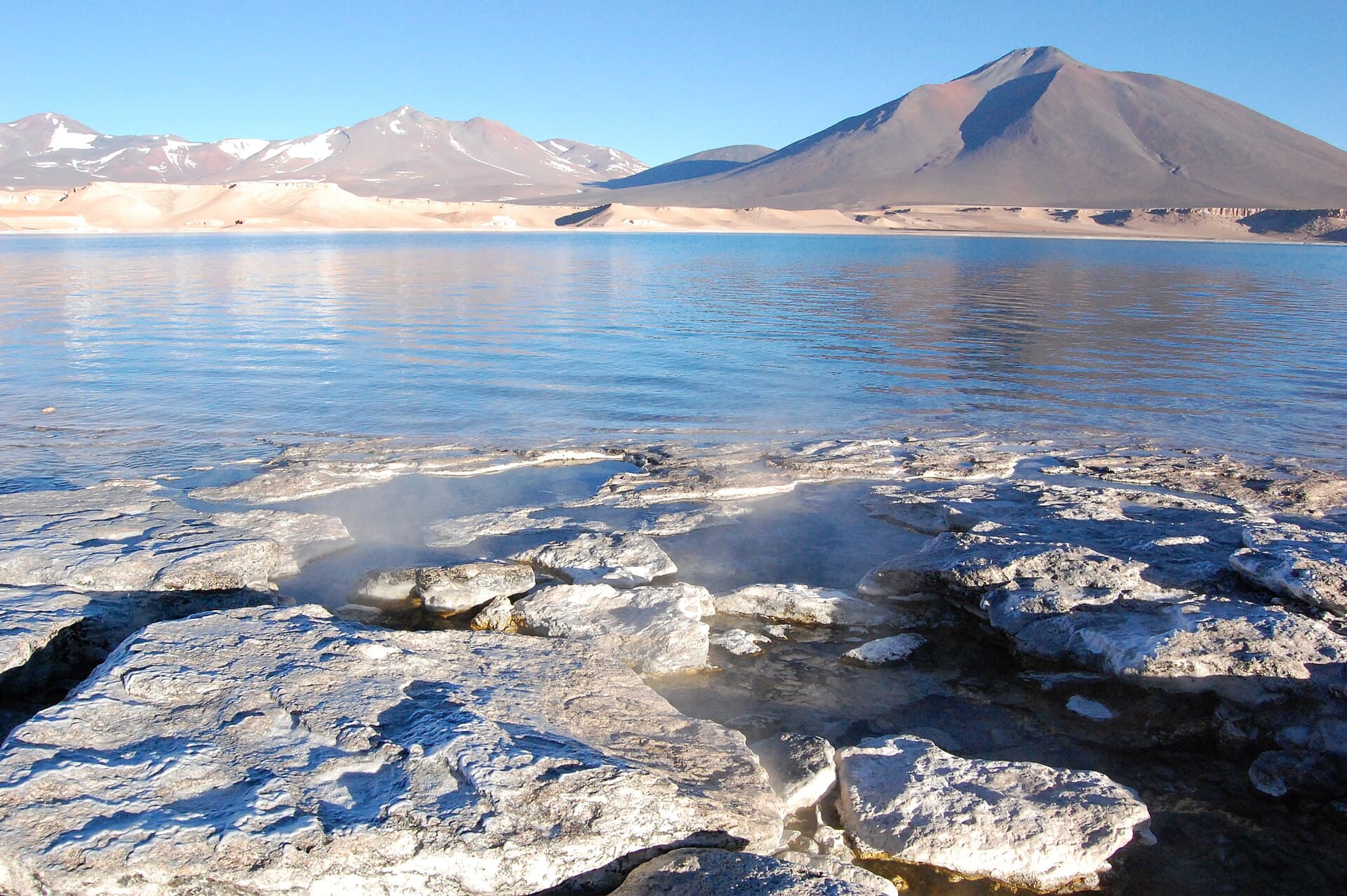
The Puna de Atacama is one of the driest and highest inhabited plateaus on Earth. Average precipitation at Laguna Verde: 181mm/year. The Atacama Desert proper receives less than 1mm/year in places. The climbing threat here is not snow and avalanche (as in the Himalaya) — it is relentless dry cold and wind with no shelter.
| Elevation | Daytime Temp | Nighttime Temp | Wind | What This Means |
|---|---|---|---|---|
| Fiambala (1,500m) | +25 to +35C | +10 to +20C | Light | Hot desert town |
| Laguna Verde (4,350m) | +5 to +15C | -10 to -15C | Moderate | Comfortable in sun, cold at night |
| Refugio Tejos (5,825m) | -5 to -10C | -20 to -25C | Strong | Sleeping bag rated to -30C minimum |
| Summit zone (6,500m+) | -25 to -30C | — | 80+ km/h | Effective wind chill below -40C |
The summit mean annual temperature is approximately -10C. Temperature swings of 30-40C in 12 hours are normal — intense solar radiation by day (the extreme aridity means low cloud cover) and rapid radiative cooling at night.
Wind is the defining feature, not altitude. Unlike Aconcagua, where storms bring moisture and whiteout conditions, the Puna threat is wind with no shelter. At summit level, gusts regularly exceed 80km/h. Mountain-forecast.com documents gusts up to 200km/h during the climbing season. Tents at high camp are damaged regularly. Wind-loading on exposed ridges can make standing difficult or impossible.
Source: Explore-Share, Wikipedia — Ojos del Salado, mountain-forecast.com
The Contrarian Calendar
Why Operators Push January-February
Most foreign climbers take holidays in January and February (Northern Hemisphere winter break, Southern Hemisphere summer). Operators schedule departure dates when clients are available, not when the mountain is at its best. The result is a concentration of expeditions during the months with the highest invierno boliviano risk.
Why December Is the Sweet Spot
- Amazon moisture has not yet reached the Puna. Storm risk is minimal
- Daytime temperatures are warming — conditions improve through the month
- Season has just opened — refugios are not yet worn down, routes are fresh
- Fewer climbers than January peak
- Operators offer early-season departures: Andes Specialists lists December 1 as the first 2026 departure
Why March Is the Second Pick
- The invierno boliviano retreats north as the South American monsoon weakens
- Stable weather returns, often resembling December's clarity
- Fewer climbers — the January-February peak has passed
- Days are getting shorter and nights colder, but still well within the climbing envelope
- Some operators offer March departures at lower prices to fill remaining spots
When to Avoid
- Mid-January to mid-February carries the highest storm risk. A climber locked in a tent at 5,800m during a multi-day whiteout burns acclimatization days, food, fuel, and morale. Even if the storm clears, the summit window may be gone
- April is a gamble. Some seasons deliver perfect windows; others deliver early winter closures. The Paso de San Francisco was closed April 14-15, 2026, due to snow on the Chilean side
Source: SummitPost, Andes Specialists, Catamarca Actual — April 2026 closure
Paso de San Francisco Seasonal Reality
The border crossing at 4,748m is the single point of failure for any itinerary that crosses between the Argentine and Chilean sides of the Puna.
| Period | Status | Notes |
|---|---|---|
| June-October | Closed | Snow, ice, road impassable |
| November | Opening | May open late. Check with Gendarmeria |
| December-March | Nominally open | But unplanned closures from snow events are common even in summer. Closed late December 2025, February 25 and April 14-15, 2026 |
| April | Unreliable | Increasingly frequent closures |
| May | Closing | Transitioning to winter shutdown |
New operating hours (effective May 4, 2026):
- La Gruta (Argentine control): 09:00-18:00, last vehicle toward Chile at 16:30
- Maricunga (Chilean control): 09:00-18:00, last vehicle toward Argentina at 15:30
These restricted hours further compress the transit window. A climber driving from Fiambala to Laguna Verde via the Paso must time the crossing carefully — departure from Fiambala before dawn to reach La Gruta by opening time.
See Getting to the Puna 6Ks for the full logistics breakdown.
Source: Catamarca Actual — schedule changes, Inforama — December 2025 closure
Peak-Specific Timing Notes
Ojos del Salado (6,893m)
The summit chimney (YDS 5.6 at ~6,850m) requires dry rock for safe passage. A fresh snowfall on the summit block can make the scramble significantly more dangerous — iced holds, reduced visibility, wind-loaded snow on the approach couloir. December and March, with their lower precipitation probability, offer better odds of dry rock on summit day.
Most Chilean-side operators schedule summit attempts for early morning (3-5AM start from Refugio Tejos) to avoid afternoon wind buildup. An 8-9 hour summit day means returning to Tejos by early afternoon — before the worst wind.
Monte Pissis (6,793m)
Pissis has a glacier starting at ~5,900m. January-February invierno boliviano events can deposit fresh snow on the glacier, changing conditions between Camp 2 and the summit. Crampons are recommended regardless of month. The total exposure on summit day (12.71km, +2,187m from base camp) means a weather window of 12+ hours is needed.
Volcan San Francisco (6,018m)
The most weather-tolerant of the three. No glacier, no technical terrain. A 9-10 hour round trip from the ~4,829m start point means a dawn start and afternoon return. Summit day weather windows are shorter (afternoon storms build faster in January-February), but the non-technical route reduces the consequence of marginal conditions.
What to Bring for Puna Weather
The Puna weather equation is simple: extreme UV during the day, extreme cold at night, wind at all times.
| Item | Spec | Why |
|---|---|---|
| Sleeping bag | Rated to -30C / -22F | Refugio Tejos interior drops below -20C. Tent camping on Argentine side is colder |
| Down jacket | 800+ fill, full hood | Summit day and all evenings above 5,000m |
| Hardshell jacket | Gore-Tex or equivalent, full hood | Wind protection is the primary function |
| Windproof pants | Not optional | Wind at 6,000m+ shreds soft-shell fabric |
| Glacier glasses | Category 4 | Atacama UV is extreme. Snow blindness risk is real above 5,500m |
| SPF 50+ sunscreen | Lips, ears, neck, hands | Altitude + Atacama UV = burns through cloud cover |
| Balaclava / buff | Wind protection for face | Wind chill at -30C causes frostbite in minutes on exposed skin |
The UV intensity in the Puna de Atacama is among the highest on Earth. Clear skies, thin atmosphere, high altitude, and reflective volcanic surfaces combine to create UV levels that cause burns within 15-20 minutes of unprotected exposure.
The calendar
| Timing | Rating | Best For |
|---|---|---|
| Early December | Best | First departures, stable weather, warming temps |
| Late December | Excellent | Peak warmth building, pre-monsoon stability |
| Early January | Good but risky | Warm, but invierno boliviano risk begins |
| Mid-Jan to mid-Feb | Risky | Peak storm risk. Still warm. Most operators' peak season |
| Late February | Moderate | Storm risk declining, wind increasing |
| March | Excellent | Storms gone, stable, fewer crowds, cooling |
| Early April | Marginal | Shorter days, possible early winter, empty mountain |
The climbers who summit in the best conditions are the ones who arrive in early December or March — the months that most English-language guides bury in the "shoulder season" footnote.
10 Sources
- summitpost.orgSummitPost — Ojos del Salado (Tier 2)
- summitpost.orgSummitPost — Puna de Atacama (Tier 2)
- en.wikipedia.orgWikipedia — Ojos del Salado (Tier 2)
- explore-share.comExplore-Share — Ojos del Salado Facts (Tier 3)
- andes-vertical.comAndes Vertical — Ojos del Salado Expedition (Tier 3)
- andes-specialists.comAndes Specialists — Ojos del Salado (Tier 3)
- allmountain.clAllMountain Chile — Ojos del Salado (Tier 3)
- mountain-forecast.commountain-forecast.com — Ojos del Salado (Tier 2)
- catamarcactual.com.arCatamarca Actual — April 2026 Paso closure (Tier 2)
- catamarcactual.com.arCatamarca Actual — Paso schedule changes (Tier 2)