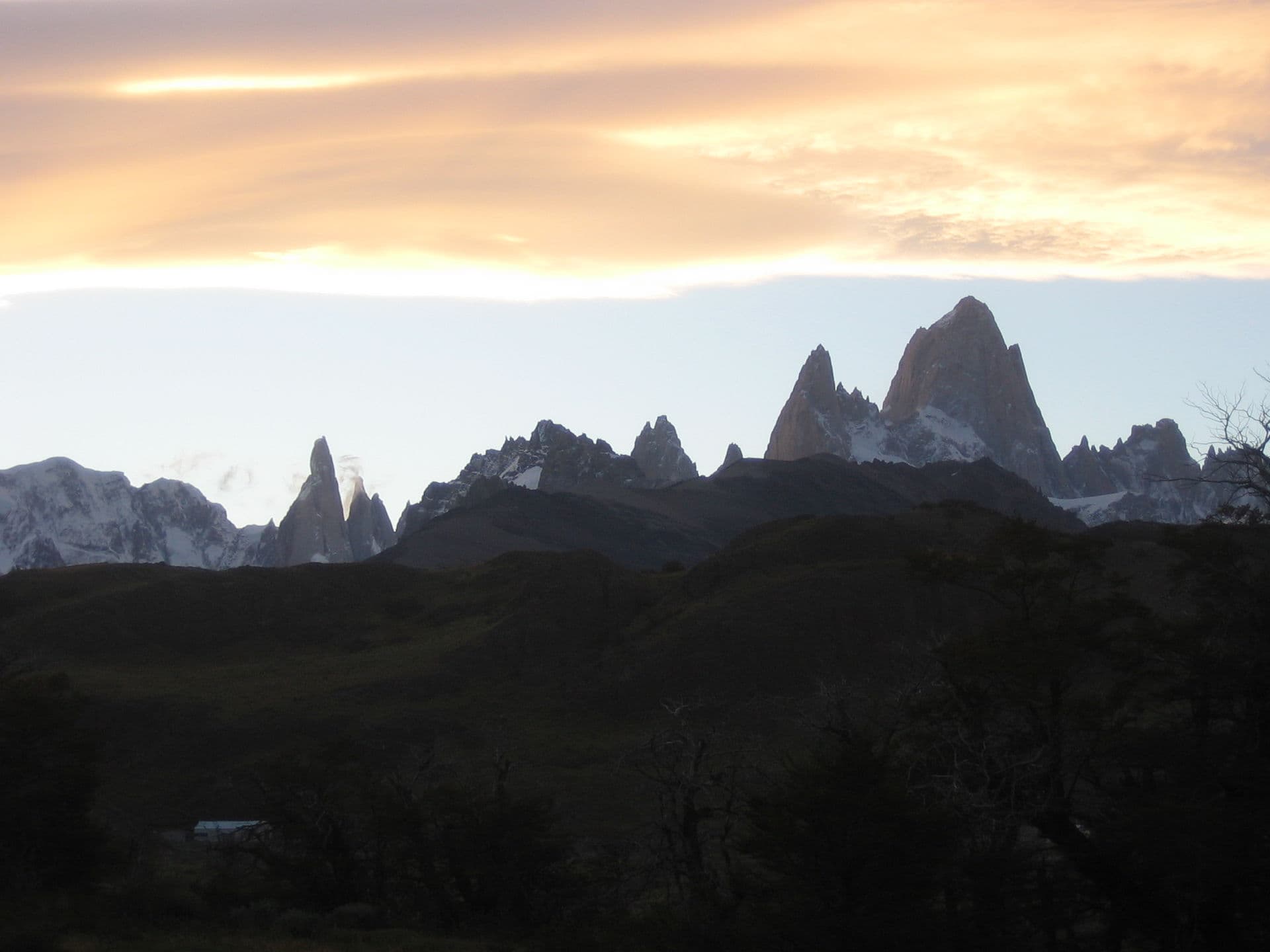
The mountain is called "the smoker"
Before anything else about weather windows, wind speeds, or crowd curves, absorb one fact. The Aónikenk — the southern Tehuelche who lived on the steppe east of the Chaltén massif for centuries before Europeans drew a border through it — named the mountain Chaltén. The word translates roughly as "the smoker," or "the one that smokes." Pre-Darwinian Europeans, seeing the near-permanent cloud cap that forms as moist Pacific air is forced upward by the massif, reasonably assumed it was a volcano. It isn't. The "smoke" is a lenticular cloud cap, and it is there most of the time.
This is the detail that should anchor every decision you make about when to go. The weather around Fitz Roy is not a footnote to your trip. It is not a chapter. It is the entire story, and everything else — your flight dates, your number of nights in town, your day-by-day plan, the order in which you tackle the trails, whether the Huemul Circuit is on the table at all — is a variable you fit around it. Any itinerary that treats the weather as something to "be prepared for" on page three of a packing list has started from the wrong frame.
The 1952 French first-ascent team spent weeks sieging Fitz Roy, waiting for windows. Climbers still do. The rangers at the APN visitor centre in El Chaltén post a wind forecast every morning and locals check it the way Nepali guides check the monsoon. This is not a mountain you visit. It is a mountain you wait for.
The 20–35% visibility problem
No formal APN climatology is publicly published for the Chaltén sector of Los Glaciares. What exists is the convergent testimony of operators, climbers, and repeat visitors: in peak season, Fitz Roy is visible from town for roughly 20–35% of daylight hours. That figure is not bad luck. It is the baseline the mountain generates for itself by sitting where it sits, doing what it does.
What that means in practice:
- A two-night visit has meaningful probability of never seeing the summit at all. Not "might have bad weather" — literally never see the mountain your trip was designed around.
- A three-night visit is a coin flip.
- A five-night visit gets you to a reasonable probability of at least one clear-Fitz-Roy day.
- Six to seven nights is our recommendation for travellers who flew across a hemisphere and don't want to go home with a photo of cloud.
Every experienced operator page in El Chaltén — not the affiliate blogs, the ones actually run out of town — tells you the same thing: plan a minimum five-night stay if seeing Fitz Roy clear is a priority of the trip. Source: elchalten.com — the weather in El Chaltén.
Choose the month that stacks the odds. The month you choose is not a question of "when is it warmest" or "when are the days longest." It is a question of which month gives you the highest probability of walking into one of those 20–35% windows while you are standing on the trail.
Continue reading El Chaltén is not a wilderness. It's a climbing-town basecamp — and the free-access regime just ended. →
Wind — the viento blanco
The second number to internalize is wind speed. El Chaltén sits at the base of a massif that acts as the first obstacle in ~12,000 km of open Pacific and Southern Ocean fetch. The Patagonian westerlies hit it, deflect upward, and accelerate around and over the towers. The results are unambiguous:
- Average summer wind at town level: roughly 30 km/h sustained. connectpatagonia.com — El Chaltén weather.
- Winter peaks: gusts to 150 km/h. Trekkers do not go in winter.
- Huemul Circuit passes (Paso del Viento, Paso Huemul): 100–160 km/h routinely. Adventure Alan and every other detailed Huemul write-up describe these as "strong enough to literally stop a loaded hiker." adventurealan.com — Huemul Circuit. See the full Huemul Circuit guide for what the guide websites leave out.
There are formal turn-back protocols on three routes: Paso del Viento and Paso Huemul on the Huemul Circuit, and the Loma del Pliegue Tumbado summit. Rangers at the APN visitor centre post a go/no-go assessment every morning. On peak-wind days they will tell you not to go. On marginal days they will tell you your call. Listen to them — they live there.
And here is the uncomfortable part the December consensus does not mention: December is the windiest month of the year in the Chaltén massif. Average sustained wind of roughly 13.9 kts / 25 km/h, with gusts of 40–60 km/h common throughout the October–March shoulder and peak. Source: climate-data.org — El Chaltén.
December is the month with the most daylight. It is also the month the wind hates you most. These facts are not a coincidence — both track the same solar forcing that drives the circumpolar pressure gradient. Long days mean strong wind. You cannot have the one without the other.
Month by month, plainly
| Month | Wind | Crowd | Visibility | Daylight | Huemul viable? | Verdict |
|---|---|---|---|---|---|---|
| October | Moderate, building | Very low | Unstable | 12–14 h | Rarely — snow on passes | Specialists only |
| November | High and rising | Low–moderate | Best (driest air) | 14–16 h | Marginal, check rangers | Sweet spot for day hikes |
| December | Peak | High, rising | Poor (wind + cloud) | 16–17 h | Yes, but windiest | Worst month for wind + crowds |
| January | High | Peak | Moderate | 16 h | Yes, in windows | Warmest, most crowded |
| February | High, easing late | Peak, easing late | Moderate–good | 14–15 h | Yes, most reliable | Most balanced for first-timers |
| March | Easing | Thinning | Improving | 12–13 h | Yes — sweet spot | The climber's secret |
| April | Variable | Very low | Variable | 11–12 h | Closing | Repeat visitors only |
| May–Sept | Extreme (150 km/h gusts) | None | N/A | 8–10 h | No | Skip unless a specialist |
October — shoulder shoulder
Snow lingers on Paso del Viento and on the final moraine scramble to Laguna de los Tres. Many operators are not yet open. Campgrounds are still ramping. The Huemul is usually not viable — the pass will be snowed up and the rangers will say no. Skies are unstable but crowds are essentially absent. Go in October if you are a hardened trekker with flexibility and you understand you may not complete your headline objective.
November — the driest month, qualified
November is, statistically, the driest month of the year in El Chaltén. Average relative humidity drops to around 32.9%, the lowest of any month. Average sunshine is ~9.9 hours per day. Cloud cover averages are also at their lowest. Daylight is close to the solstice maximum (sunrise ~05:30, sunset ~21:30). Source: wanderlog.com — El Chaltén weather in November.
The tradeoffs are real:
- Wind is building. November is not calm. It is drier than December but the westerlies are ramping, and by late November the average approaches December levels.
- Huemul is a question mark. Paso del Viento can still be snowed up into early November, and the ranger assessment is more likely to be "no" than it will be in February or March.
- Some town services and trail campgrounds are still opening. Reservation windows at Amigos del Parque sites (Poincenot, De Agostini) open earlier each year but physical facilities open later.
The upside is substantial: if your priority is clear day hikes with Fitz Roy visible and the Huemul is not on your list, November arguably beats every other month in the calendar. The driest air means the best visibility averages even though the wind is higher. You pay for the clear air with gust-days that keep you off exposed ridgelines.
December — the peak-season trap
December is the month every English-language guide pushes. Here is what December actually delivers:
- Windiest month of the year. Not "one of the windy months" — the windiest, measured. climate-data.org.
- Peak crowds ramping fast. By mid-December the Laguna de los Tres trail carries over a thousand walkers a day.
- Sunset at ~22:00. Genuinely long days — this is real and it photographs well on Instagram.
- Unstable weather. The transition from spring to summer means rapidly changing conditions.
- Christmas and New Year price spikes on flights, hostels, cabañas, guided services.
The daylight is real. Nothing else about December is a win. You are paying peak price for peak wind and peak crowds, and the only statistic you win on is sunset hour. If you are flying across the world for one week in the Chaltén massif, December is the month to avoid unless your schedule is rigid and December is all you have.
January — warmest and most crowded
January is the warmest month of the year. Average high around 17°C, average low around 5°C. The valley is full. Every cabaña, hostel, and restaurant is booked. The Huemul is doable in windows but the tyrolean-traverse queue on Day 2 can add 1–3 hours of waiting. If you are a first-time trekker who needs warmth and maximum services and you are not sensitive to crowds, January works. If you are anyone else, January is the second-worst month after December.
February — the most balanced
February is the quiet winner of the peak-season months. Similar temperatures to January, slightly drier on average, wind starting to ease in the second half, crowds still high but thinning by the last week. If you cannot travel in March and you need peak-season reliability, book the last two weeks of February rather than any week in December or January.
March — the climber's secret
This is the month this article is really about.
Why March works:
- Lower wind. The westerlies ease as the southern summer transitions toward autumn. Average wind speeds drop noticeably from the December peak.
- Thinner crowds. Most international trekkers have left. The town shifts back toward a climber/local-Argentine mix. Trail campgrounds are booked at 30–50% of January levels rather than 100%.
- Better visibility. Repeat visitors, alpine climbers, and operator pages that are not writing for peak-season affiliates converge on the same claim: late February through mid-April has the highest proportion of clear, calm days. The wet/windy air masses that dominate December are replaced by drier continental air and the cloud cap sits more gently on the summit. Source: wanderlog.com — El Chaltén weather in March.
- Autumn colour. The Ñire and Lenga forests around Chorrillo del Salto, Laguna Torre, and the lower Laguna de los Tres trail turn red and gold. This is not a trivial aesthetic footnote — it transforms the walk in. December photographs cloud. March photographs the ground itself.
- Huemul still viable. Contrary to intuition, the second half of February and the first half of March is arguably the best window for the Huemul Circuit. Passes are clear of lingering snow, wind is easing from peak, daylight is still adequate (12+ hours), and the queues at the tyrolean traverses are shorter. Source: championtraveler.com — best time to visit El Chaltén.
- Daylight is still enough. Sunrise around 07:00, sunset around 20:00 by mid-March. That's 12–13 hours, more than enough for any day hike in the valley including the 8–10 hour Pliegue Tumbado outing.
- It is colder. Bring layers. Average high ~8°C, average low ~1°C. This is not a warm month. You need a shell, gloves, a warm hat, and a genuine base-layer system. This is the tradeoff you accept for everything else.
- Flights and beds are cheaper. Shoulder pricing, better availability, no Christmas spike.
Who March is wrong for: travellers who need warmth, travellers who want the 22:00 sunset, travellers whose entire schedule is locked to a December–January window, and climbers specifically targeting the peak climbing season (which is early November to late February — a separate optimization from the trekking calendar).
For everyone else, March is the answer the December consensus is hiding.
April — closing the door
Early April can still be excellent; late April starts to deteriorate. Most operators close for the season mid-to-late April. Weather becomes genuinely variable. Daylight drops to 11 hours and falling. Cold is real. Go in April only if you have been to Chaltén before, you know which trails you want, and you accept that you may lose days to the first real autumn storms.
May–September — skip
Gusts reported to 150 km/h. Daylight 8–10 hours. Many services closed. Trails snowbound at higher elevations. The Huemul is not happening. Unless you are a specialist with winter alpine skills visiting climbers or the frozen massif for reasons that have nothing to do with trekking, the winter months in Chaltén are off-limits to normal visitors.
Planning this route? We're forming a founding group for Huemul Circuit — Self-Guided Cohort — registering interest is free, no commitment. See the expedition →
Why do all the blogs push December?
Short answer: it is not because December has the best weather. The data is unambiguous that it doesn't.
Three reasons the December consensus exists:
- Partner operator capacity. Affiliate-driven blogs are pointing you at the months their partner operators — guiding services, cabañas, tour aggregators — have the most inventory and the best commissions. That window is December through February. In March many of those partners have wound down their season-long sales pushes.
- Affiliate-relationship alignment with peak season. Commissionable products (Viedma glacier day tours, premium guided Huemul, ice trek, mini-trek Perito Moreno combos) are packaged and marketed for the peak window. If a blog is quietly earning on booking flows, its calendar recommendation tracks booking volume, not weather.
- The 22:00 sunset is photogenic and sells on Instagram. A 22:00 sunset is a real thing and it looks spectacular. It is also the only genuine advantage December has over February and March on any axis a visitor actually cares about. That advantage is doing a lot of work in marketing copy.
None of this is conspiracy. It is the standard incentive structure of affiliate-driven travel publishing in 2026. The result is a calendar consensus that optimizes for tour-operator booking volume rather than for the traveller's probability of seeing the mountain. When those two optimizations conflict — and on El Chaltén weather, they conflict hard — the traveller loses.
Planning-critical claims in this article carry source links.
Fitz Roy visibility strategy, regardless of month
Whichever month you pick, the strategy for maximizing your chance of a clear Fitz Roy day is the same:
- Budget at least five nights in town, ideally six or seven. This is the single most load-bearing trip-planning decision. Fewer nights radically increases the probability of never seeing Fitz Roy.
- Do not plan a tight day-by-day itinerary. Plan a menu of possible activities — Laguna de los Tres, Laguna Torre, Pliegue Tumbado, Chorrillo del Salto, Lagunas Madre e Hija, a Viedma glacier day — and pick each morning based on the wind and visibility forecast the rangers post at the Centro de Informes Ceferino Fonzo at the south edge of town. The right framing is: the menu is yours, the chef is the weather.
- Keep a rest-day activity in the mix for bad weather. Chorrillo del Salto (a flat 6 km round trip to a waterfall through forest), a town day, a shorter loop to Laguna Capri. These are activities that work even when Fitz Roy is a grey wall and the wind is at the limit.
- Check the ranger forecast every morning. Not the generic weather app — the rangers. Their call is based on local mountain experience and they see the same data windflyers see but with twenty years of pattern-matching on top.
What this means for the Huemul Circuit specifically
The Huemul Circuit deserves its own month-by-month call because it is the one objective in Chaltén where the wrong month will get you turned back by rangers.
- Early season (November): Paso del Viento may still be snowed up; rangers may refuse permits or strongly discourage. Check in person before committing.
- Peak season (December–early January): wind is the most likely reason for turn-back. The tyrolean traverse queue on Day 2 is at its worst. You will probably get through, but you will work for it.
- Mid-to-late peak (mid-January–February): wind still high but windows more frequent; queues persistent.
- Late peak to early shoulder (late February–early/mid March): the genuine sweet spot. Warming passes are fully clear of snow, wind is easing from December maximum, daylight is still 12+ hours, queues are short, weather windows are both longer and more frequent.
- Late March–early April: closing window. Still viable for hardened parties with cold-weather gear and flexibility to wait out storms, but the margin for error is shrinking every week.
If the Huemul is your headline objective, book February 15 to March 15 and you will have picked the best four-week window of the year.
The cold and the insurance — the unglamorous reality
Two practical facts that do not show up in any seasonal marketing:
Argentina legally requires travel insurance with at least USD 20,000 in medical coverage for foreign visitors, as of May 2025. This is not optional. Many 2024 blog posts still describe it as recommended. Source: trips-southamerica.com — Argentina travel requirements 2025.
Rescue in the Chaltén massif is performed by a volunteer body. The Comisión de Auxilio de El Chaltén, a group of local climbers, is the de facto rescue authority in the massif regardless of federal funding cycles. Response times for trekker rescues are 6–24 hours, ground evacuation only. Helicopter access is limited and wall rescues are, historically, not survivable — the Chaltén massif has never recorded a successful wall rescue. For a trekker injured on Paso del Viento in wind or on the Los Tres moraine scramble, the answer is 6–24 hours of ground response from volunteers.
Cold + wind = real hypothermia risk even in "summer." A 25 km/h sustained wind at 4°C produces a wind chill equivalent near 0°C. Gusts of 60 km/h at the same temperature are genuinely dangerous in damp clothing. Bring a real shell, real layers, real gloves, and a real hat, regardless of which month you pick.
The one-sentence answer
If you have schedule flexibility and the goal is to maximize your probability of seeing Fitz Roy clear while paying less, walking with fewer people, and keeping the Huemul on the table, the best window in the calendar is mid-February through mid-March, with the close runner-up being mid-to-late November; December is the month the affiliate blogs push and the month the wind hates you most, and neither of those facts is a coincidence.
12 Sources
- elchalten.comelchalten.com — The weather in El Chaltén — operator-maintained weather and visibility guidance from in-town.
- en.climate-data.orgclimate-data.org — El Chaltén climate data — month-by-month temperature, wind, humidity, and precipitation averages.
- wanderlog.comwanderlog.com — El Chaltén weather in November — November humidity, sunshine, and daylight statistics.
- wanderlog.comwanderlog.com — El Chaltén weather in March — March temperature, sunshine, and wind data.
- championtraveler.comchampiontraveler.com — Best time to visit El Chaltén — visibility and crowding analysis across the calendar.
- connectpatagonia.comconnectpatagonia.com — El Chaltén weather — wind averages and viento blanco context.
- adventurealan.comadventurealan.com — Huemul Circuit El Chaltén Patagonia — Huemul wind speeds, pass protocols, and gear guidance.
- journeylatinamerica.comjourneylatinamerica.com — When to go, El Chaltén and the Fitz Roy massif — operator guidance on minimum-stay length and visibility probabilities.
- worldlyadventurer.comworldlyadventurer.com — Best time to visit Patagonia — broader Patagonia seasonal context.
- quasarex.comquasarex.com — November in Patagonia — shoulder-season conditions overview.
- trips-southamerica.comtrips-southamerica.com — Argentina travel requirements 2025 (mandatory travel insurance) — the USD 20,000 minimum-coverage requirement.
- Casamiquela, Rodolfo. Tehuelche toponymy works (CENPAT-CONICET). Canonical source on the Aónikenk etymology of Chaltén as "the smoker."