I. The mountain before
Before April 10, 1815, Mount Tambora stood approximately 4,300 meters tall -- one of the highest peaks in the Indonesian archipelago. It rose from the Sanggar Peninsula on the northern coast of Sumbawa, a large island in the Lesser Sunda chain east of Lombok and west of Flores. The mountain was a stratovolcano, built over thousands of years by alternating layers of lava, ash, and pumice from the subduction of the Indo-Australian Plate beneath the Eurasian Plate -- a tectonic process that has produced the entire volcanic arc of Indonesia.
On the slopes of Tambora and the surrounding lowlands, three principalities had established themselves: the kingdoms of Tambora, Pekat, and Sanggar. The largest of these, the kingdom of Tambora, supported approximately 10,000 inhabitants who traded in honey, horses, sappan wood, and sandalwood. The society was governed by a sultan -- Raja Abdul Gafur -- and had adopted Islam several centuries earlier than neighboring regions like Bima. The Tamboran civilization was a wealthy maritime hub, positioned inland to avoid pirate raids on the coast, connected by trade routes to Vietnam and Cambodia.
The people of the Tambora kingdom spoke a language that was not Malay. It was not Austronesian at all. The Tambora language was a linguistic isolate -- a non-Austronesian tongue more closely related to the Mon-Khmer language group of mainland Southeast Asia than to any of its neighbors. It was, as far as linguists can determine, the last surviving pre-Austronesian language in central Indonesia. British colonial officials who visited the region shortly before the eruption recorded 48 words of the language. That is all that survives.
The mountain had been rumbling since 1812. Minor eruptions generated dark clouds around the summit. Tremors were reported across Sumbawa. Nobody understood what was building.
II. April 5, 1815
On April 5, the mountain exploded with a force that was, in retrospect, a rehearsal. The eruption produced a Plinian column 33 kilometers tall at an eruption rate of 1.1 x 10^8 kg/s. The sound carried across the archipelago.
Thomas Stamford Raffles, the British lieutenant-governor of Java, heard the blast at his residence -- 1,260 kilometers away -- and assumed it was cannon fire. He dispatched troops from Djogjokarta to investigate what he believed was a naval engagement or an attack on a neighboring post. At Makassar on the southwestern tip of Sulawesi, 380 kilometers northeast of Tambora, the commander of the Benares, a cruiser of the British East India Company, reported hearing "a firing of cannon" that appeared to come from the south. He sent another vessel to investigate. It returned empty-handed. On Ternate, 1,400 kilometers away in the Molucca Islands, the British resident heard "several very distinct reports like heavy cannon" and dispatched a cruiser of his own. Also nothing.
It was not nothing. It was a volcano clearing its throat.
Continue reading Bromo, Agung, Ijen — the volcanic circuit that runs on jeeps, ceremonies, and sulfur →
III. April 10, 1815
Five days later, Tambora detonated.
At approximately 7:00 pm local time on April 10, the eruptions intensified catastrophically. Three eruption columns rose and merged into a single pillar that punched 43 kilometers into the stratosphere -- well above the tropopause, deep into the layer of atmosphere where material can circle the globe. The climactic eruption rate reached 2.8 x 10^8 kg/s. Pumice stones up to 20 centimeters in diameter began raining down at 8:00 pm, followed by ash at 9:00 to 10:00 pm. A violent whirlwind struck the village of Sanggar, tearing every house from its foundations and carrying trees, animals, and people into the air.
The eruption measured VEI-7 on the Volcanic Explosivity Index -- the most powerful volcanic eruption in recorded human history and the most recent confirmed VEI-7 event on Earth. The VEI scale is logarithmic: each integer represents a tenfold increase in ejecta volume. Tambora ejected approximately 160 cubic kilometers of tephra into the atmosphere. In dense-rock equivalent -- the measure volcanologists use to normalize for the porosity of pumice and ash -- that is 37 to 45 cubic kilometers of solid rock, pulverized and launched into the sky.
To put the scale in context: Tambora ejected roughly ten times more material than Krakatoa would in 1883, and approximately one hundred times more than Mount St. Helens in 1980. It was a full order of magnitude larger than Mount Pinatubo in 1991, which itself caused measurable global cooling. The Tambora eruption was roughly twenty times the size of Vesuvius in 79 AD, the eruption that buried Pompeii.
The sound was heard 2,600 kilometers away in Sumatra -- roughly the distance from London to Reykjavik, or from New York to Denver. Some reports suggest it was heard even farther -- over 3,350 kilometers away in Thailand and Laos.
IV. The pyroclastic flows
The eruption column collapsed repeatedly, generating pyroclastic flows -- superheated avalanches of gas, rock, and ash at temperatures up to 1,000 degrees Celsius, hot enough to melt glass. The flows cascaded down every flank of the mountain, sweeping across 874 square kilometers of land and into the sea on all sides of the Sanggar Peninsula. They propagated 15 to 20 kilometers across land and 15 to 30 kilometers across the ocean surface before reaching the opposite shore of Saleh Bay.
The entry of pyroclastic flows into the ocean generated tsunamis. Waves up to 4 meters high struck the coast of Sanggar around 10:00 pm, with some estimates suggesting waves reached 10 meters in certain areas. Approximately 4,600 people died from tsunamis alone.
The kingdoms of Tambora and Pekat were obliterated. Neither their populations nor their rulers survived. Raja Abdul Gafur of Tambora and Raja Muhamad of Pekat were both killed, along with every person in their territories who had not already fled. The village of Tambora and its 10,000 residents were incinerated and buried.
Pitch darkness was observed as far as 600 kilometers from the summit for up to two days. Ash fall exceeded 100 centimeters deep within 75 kilometers of the eruption, reached 5 centimeters at 500 kilometers, and was detectable as far as 1,300 kilometers away.
The mountain itself lost 1,400 meters of summit elevation. Where a 4,300-meter peak had stood, there was now a caldera.
V. What was lost
The death toll from Tambora reached approximately 92,000 people, though some estimates push the total above 100,000. Of these, 10,000 to 12,000 were killed directly by the eruption -- pyroclastic flows, the blast, falling debris, and tsunamis. The remaining 80,000 or more died in the weeks and months that followed, from starvation and disease, as a thick blanket of volcanic ash destroyed all agriculture across Sumbawa and neighboring Lombok. Crops were smothered. Livestock died. Water sources were contaminated. Famine and epidemic swept through populations that had survived the eruption itself.
It is the deadliest volcanic eruption in recorded human history.
But the death toll, catastrophic as it is, understates the totality of what was destroyed. The Tambora eruption did not merely kill people. It erased a civilization. The Tambora kingdom -- its social structures, its architecture, its trade networks, its religion, and its language -- ceased to exist. The Tambora language went extinct. Not gradually, through assimilation or cultural shift, but instantly, through geological annihilation. An entire way of speaking -- the last survivor of the pre-Austronesian languages of central Indonesia, a linguistic thread connecting Sumbawa to mainland Southeast Asia -- was silenced in a single night.
In 2004, University of Rhode Island volcanologist Haraldur Sigurdsson led a six-week archaeological excavation on the flanks of Tambora. His team unearthed the remains of two adults alongside bronze bowls, ceramic pots, iron tools, and the carbonized remnants of a home -- all buried under meters of pyroclastic deposits. The artifacts showed cultural connections to Vietnam and Cambodia. Sigurdsson described the site as "the Pompeii of the East" -- a civilization frozen in the moment of its destruction, still encapsulated beneath the ash exactly as it existed in 1815.
The comparison is apt, but the scale is not. Vesuvius killed roughly 2,000 people and buried one city. Tambora killed 92,000 and erased three kingdoms, a language, and a culture. Pompeii has been excavated for centuries, visited by millions, and has its own UNESCO designation. The lost kingdom of Tambora has had one six-week dig.
VI. The stratospheric veil
The eruption's immediate destruction was local. Its atmospheric consequences were global.
Tambora injected an estimated 60 to 80 megatons of sulfur dioxide into the stratosphere -- some sources estimate as high as 100 megatons. In the stratosphere, sulfur dioxide combines with water vapor to form sulfuric acid aerosol droplets -- microscopic particles that reflect incoming solar radiation back into space before it can reach Earth's surface. These particles do not wash out with rain. They persist for years, circling the globe in the stratospheric winds, forming a veil between the sun and the ground.
Within weeks of the eruption, Tambora's sulfate aerosol cloud had encircled the planet. The veil was visible to the naked eye. Across Europe and North America, people observed a persistent reddish "dry fog" that dimmed sunlight, sometimes to the point where sunspots could be seen with the unaided eye. Neither wind nor rain dispersed it. It hung in the sky for years, tinting sunsets vivid orange and red across the Northern Hemisphere.
Nobody understood what it was. The science of atmospheric chemistry did not yet exist. The eruption in the Dutch East Indies was not global news. People in 1816 saw the fog, felt the cold, watched their crops fail, and had no framework to explain any of it.
VII. 1816 -- the year without a summer
The global average temperature dropped by 0.4 to 0.7 degrees Celsius. That number sounds trivial. It was not. Summer temperatures in the Northern Hemisphere fell by as much as 2 to 3 degrees Celsius below normal. The summer of 1816 was the coldest recorded between 1766 and 2000.
New England
In May 1816, frost killed most crops in the higher elevations of Massachusetts, New Hampshire, Vermont, and upstate New York. On June 6, snow fell in Albany, New York, and Dennysville, Maine. In Cape May, New Jersey, frost hit five nights in a row in late June. A Vermont farmer froze to death in the great snowstorm of June 17. The corn crop -- the backbone of the American food supply -- failed almost entirely; crop yields may have fallen by 90 percent in parts of New England.
The economic consequences were immediate. The price of oats rose from 12 cents per bushel in 1815 to 92 cents per bushel in 1816 -- nearly an eightfold increase. Because horses were the primary mode of transport and oats were horse feed, the price of travel itself spiked. Grain prices broadly quadrupled.
The demographic consequences were larger. Families on the subsistence frontier of Vermont and New Hampshire, already marginal, abandoned their farms and migrated west -- to western New York, to the Ohio Valley, to Indiana and Illinois. Vermont alone saw as many as 15,000 people emigrate. Among them was the family of Joseph Smith, which moved from Norwich, Vermont, to Palmyra, New York -- a relocation that would later produce the founding of the Church of Jesus Christ of Latter-day Saints. Indiana became a state in December 1816. Illinois followed two years later. The settlement of the American Midwest was accelerated, in part, by an Indonesian volcano.
Europe
The consequences in Europe were worse. The continent was still recovering from the Napoleonic Wars when the volcanic winter arrived. The result was the worst famine of the 19th century.
Grain harvests failed from Ireland to Italy. Low temperatures and heavy rains destroyed crops across Britain, France, Switzerland, and the German states. Food prices rose sharply throughout the continent. The price of bread in Britain almost doubled. Hungry people demonstrated in front of grain markets and bakeries. Food riots broke out in France, Switzerland, and the German states -- the most violent period of civil unrest on the continent since the French Revolution. Arson and looting followed the protests.
The famine triggered a major typhus epidemic between 1816 and 1819 that killed an estimated 100,000 people across Europe. Weakened by malnutrition, populations succumbed to disease that might otherwise have been survivable.
In Switzerland, famine was severe in the densely populated east. The crisis prompted government emergency food programs -- one of the earliest modern state interventions in food supply.
China
The Yunnan province of China endured a three-year famine from 1815 to 1818 caused by flooding and cold that destroyed rice crops throughout the growing season. In the aftermath, Yunnan farmers pivoted to a more reliable cash crop -- opium -- to insure their families against future harvest failures. The shift contributed to the expansion of opium cultivation that would eventually feed the global opium trade and precipitate the Opium Wars with Britain.
India
The eruption's stratospheric aerosol veil disrupted the Indian monsoon -- the largest weather system on Earth -- for two consecutive years. The altered monsoon first brought drought, then unseasonal flooding. This anomalous weather cycle altered the microbial ecology of the Bay of Bengal, giving rise to a new and deadly strain of cholera. Cholera had always been endemic to Bengal, but the climatic disruption of 1816-1817 triggered a pandemic strain that spread from India across the continent and, eventually, the world. The first cholera pandemic (1817-1824) killed hundreds of thousands.
Trace the causal chain: tectonic subduction in the Java Sea generates magma beneath Sumbawa. The magma accumulates for millennia, then releases in a single event that injects sulfate aerosols into the stratosphere. The aerosols alter the Indian monsoon. The altered monsoon changes the microbial ecology of the Bay of Bengal. A pandemic cholera strain emerges. People die in Calcutta because a mountain exploded in Indonesia.
VIII. The literature
In June 1816, a group of English writers arrived at Lake Geneva for a summer holiday. Lord Byron had rented the Villa Diodati, a mansion in the village of Cologny overlooking the lake. Percy Bysshe Shelley rented a smaller house, the Maison Chapuis, on the waterfront nearby. With them were Mary Godwin (not yet married to Percy; she would become Mary Shelley), John Polidori -- Byron's personal physician -- and Claire Clairmont, Mary's stepsister.
The weather was appalling. Rain. Cold. Gloom. Incessant, unrelenting rain in what should have been high summer in the Swiss Alps. The lake was shrouded in darkness. The sun, when it appeared at all, was dimmed by the sulfate veil of a volcano 15,000 kilometers away that none of them knew about.
Mary Shelley later described "that wet, ungenial summer" where "incessant rain often confined us for days to the house."
Confined indoors, Byron proposed a challenge: each of them should write a ghost story.
Mary Godwin, eighteen years old, struggled for days to find an idea. Then, one night, she imagined a scientist who discovers the principle of life, assembles a creature from dead matter, and is horrified by what he has made. She began writing immediately. Two years later, on January 1, 1818, she published Frankenstein; or, The Modern Prometheus -- widely regarded as the first work of science fiction.
Polidori, drawing on a fragment Byron had started and abandoned, produced The Vampyre, published in 1819 -- the first modern vampire story in English literature and the direct progenitor of the romantic vampire genre that would lead, through Sheridan Le Fanu's Carmilla, to Bram Stoker's Dracula.
Byron himself, during that same volcanic summer, wrote "Darkness") -- an 82-line blank verse poem in which the sun has been extinguished and humanity destroys itself in a world without light. Byron claimed he wrote it "at Geneva, when there was a celebrated dark day, on which the fowls went to roost at noon, and the candles were lighted as at midnight." The poem is now recognized as the first major "Last Man" narrative in English -- the template for the post-apocalyptic genre.
Three foundational works of modern literature -- the first science fiction novel, the first vampire story, the first post-apocalyptic narrative -- all produced in a single summer, in a single house, by writers imprisoned indoors by the atmospheric aftermath of a volcano they had never heard of.
IX. The sunsets
The volcanic aerosols did something else. They made the sky beautiful.
J.M.W. Turner, the English Romantic painter, produced a sketchbook of 65 watercolors of sunsets in the three years following the Tambora eruption. The sulfate aerosols in the stratosphere scattered sunlight in ways that produced extraordinary red and orange sunsets visible across Europe for up to three years after the eruption. Turner captured them obsessively.
In 2014, researchers from the University of Athens and the Academy of Athens published a study analyzing the ratio of red to green pigment in Turner's sunset paintings and cross-referencing them with known eruption dates. They found a sharp change in the red/green ratio of Turner's sunsets following each major eruption he lived through: Tambora in 1815, Babuyan (Philippines) in 1831, and Cosiguina (Nicaragua) in 1835. In each case, the paintings reddened measurably in the years following the eruption and then gradually returned to normal as the aerosols dissipated.
Turner's painting Chichester Canal (c. 1828) glows with the ethereal yellow-red light of a volcanic sunset -- the atmospheric residue of Tambora, captured on canvas. The painting is now inadvertently a scientific record of stratospheric aerosol loading in early 19th-century England.
The sulfate veil killed tens of thousands of people through famine and disease. It also produced some of the most beautiful skies in the history of art. Turner painted them without knowing why they existed.
X. The geology
Why Tambora exploded
Mount Tambora is a product of the Sunda Arc -- the chain of volcanic islands that forms the southern edge of the Indonesian archipelago, running from Sumatra through Java, Bali, Lombok, Sumbawa, and on to Flores and the Banda Islands. The arc exists because the Indo-Australian Plate is being pushed beneath the Eurasian Plate at a convergence rate of 7.8 centimeters per year. As the oceanic plate descends into the mantle, it carries water-laden sediments into zones of extreme heat and pressure. The water lowers the melting point of the surrounding rock, generating magma that rises through the overriding plate and feeds the volcanoes above.
Tambora sits approximately 180 kilometers above the active subduction zone. The magma that produced the 1815 eruption originated in the upper mantle and was further modified by melted subducted sediments, fluids from the subducted crust, and crystallization processes in magma chambers beneath the mountain. Over thousands of years, this magma accumulated in a vast chamber under the volcano, building both the mountain's height and the pressure that would eventually destroy it.
Why it was so large
Most Sunda Arc eruptions are VEI-4 or VEI-5 -- significant but not civilization-ending. Tambora's VEI-7 explosion was exceptional. The key factor was the size of the magma chamber. Tambora had accumulated an unusually large volume of evolved, volatile-rich magma over a prolonged period of repose. When the chamber finally ruptured, the release was catastrophic. The formation of the caldera -- the collapse of the mountain's summit into the emptied magma chamber -- drained the reservoir in a single event, expelling the equivalent of 37-45 cubic kilometers of solid rock in hours.
The caldera
What the eruption left behind is one of the largest volcanic calderas on Earth. The summit collapsed into the void where the magma had been, producing a crater approximately 6 to 7 kilometers in diameter and 600 to 1,100 meters deep -- measurements vary by source, with more recent studies favoring the deeper estimates. The caldera walls drop nearly vertically from the rim. The floor contains an ephemeral freshwater lake, recent sedimentary deposits, minor lava flows and domes from the 19th and 20th centuries, and active fumaroles -- steam vents along the caldera walls that indicate ongoing volcanic activity beneath the surface.
The volcano is not dead. It is dormant.
Current activity and monitoring
Tambora's last eruption was in 1967 -- a gentle, non-explosive event rated VEI-0. The mountain is monitored by PVMBG (Indonesia's volcanological agency) from a monitoring post at Doro Peti village, using seismographs to track seismic and tectonic activity. It is currently at Alert Level I (Normal).
Could it happen again?
Not at Tambora, most likely. The 1815 eruption drained the magma chamber that had built up over millennia. Another VEI-7 eruption from the same volcano would require the re-accumulation of a comparable magma volume -- a process that takes thousands of years. The USGS assesses the likelihood of a VEI-7 eruption from Tambora in the near future as relatively small.
But the question is not whether Tambora itself will erupt again at VEI-7. The question is whether any volcano will. Research published in Geosphere estimates the global recurrence frequency of VEI-7 eruptions at approximately one to two per millennium. The geological record shows VEI-7 events at Tambora (1815), Rinjani (1257), Kikai in Japan (~7,200 years ago), and Crater Lake in Oregon (~7,700 years ago). Tambora was the most recent, but it will not be the last. The world's population was under 1 billion in 1815. It is now over 8 billion. Approximately 312 million people live within 100 kilometers of the 136 volcanoes assessed as having VEI-7 potential.
XI. What Tambora looks like today
The mountain that erased a summer and created Frankenstein is still there. It is simply a different mountain.
Where the 4,300-meter summit once stood, a caldera 6 to 7 kilometers across yawns open like a wound in the landscape. The rim sits at approximately 2,850 meters. From the caldera edge, you look into the absence of 1,400 meters of mountain. The caldera walls drop steeply to a floor where steam rises from fumaroles and an ephemeral lake pools in the volcanic depression. It is one of the largest volcanic craters on Earth, and it is the direct negative impression of the most powerful eruption in recorded history.
The flanks of the mountain have regrown. Two centuries of tropical succession have covered the slopes in dense forest that was sterilized by pyroclastic flows in 1815. The lower elevations are home to coffee farms -- the primary agricultural economy of the Tambora region today. Higher up, the forest transitions to grassland and eventually to bare volcanic rock at the rim. Endemic birds and unique vegetation colonize the upper slopes.
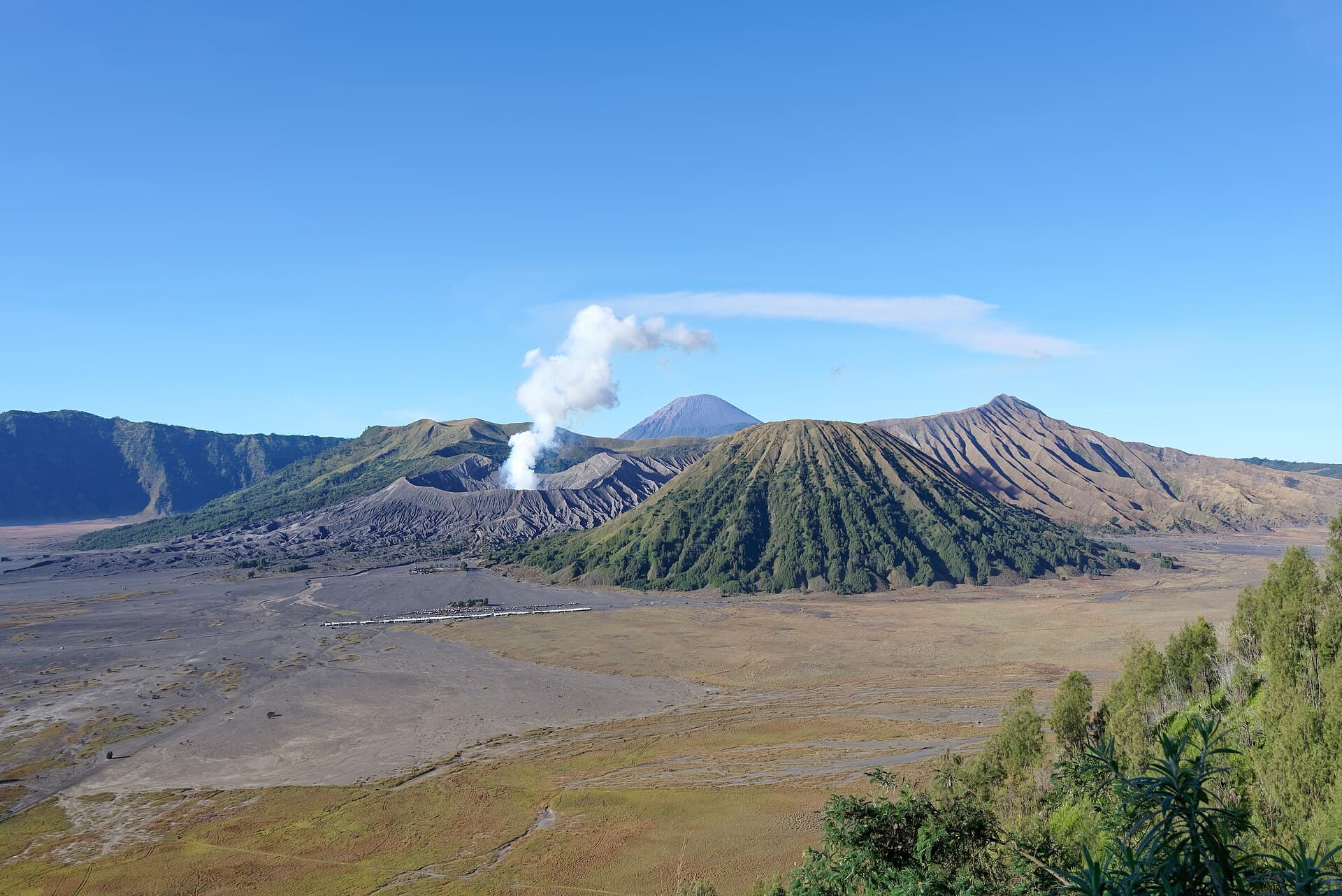
The visual experience of Tambora is not scenic in the way that Rinjani's turquoise crater lake is scenic, or in the way Bromo's sunrise caldera is scenic. There is no photogenic lake. There is no blue fire. There is a hole in the Earth where a mountain used to be, surrounded by the forest that grew back after everything was burned. The spectacle at Tambora is geological -- it is the scale of what is missing that tells you the scale of what happened.
XII. The trek
Routes
There are four designated hiking trails on Mount Tambora: Pancasila, Doro Ncanga, Oi Marai, and Piong. The two most commonly used are:
Pancasila Route (north side). The most popular route for reaching the summit. Starting from Pancasila village at 740 meters elevation, the trail passes through coffee farms and tropical forest across five posts. It is the only route from which the summit can be completed in a 3-day/2-night itinerary. The total hiking time from Pancasila to the caldera is approximately 14 hours spread across the ascent days.
Doro Ncanga Route (south side). An alternative approach that follows a different path through the forest. The Doro Mboha village access point on the south side is also used.
Getting there
Sumbawa is not on the standard Bali-Lombok-Flores tourist circuit. Reaching Tambora requires deliberate routing:
By air: Fly domestically to Sultan Muhammad Salahudin Airport (BMU) in Bima, on the eastern end of Sumbawa. Wings Air operates direct flights from Bali taking approximately 1 hour 15 minutes. Alternatively, fly to Sultan Muhammad Kaharuddin III Airport (SWQ) in Sumbawa Besar on the western end, with connections from Lombok (30 minutes).
By ferry: From Lombok's Kayangan Port to Sumbawa's Poto Tano Port, ferries depart roughly every hour, taking 1.5 to 2 hours. From Poto Tano, the overland drive to the Tambora trailheads is 4 to 6 hours depending on departure point and road conditions.
By road: From Bima, the drive to the Pancasila trailhead takes approximately 4 to 5 hours.
The logistics
There is no walk-up infrastructure. No ticket booth. No e-booking system. No daily quotas.
Guides are arranged through local operators or directly through villages at the base of the mountain. They are essential for navigation, permit logistics, and safety -- the trails are not always well-marked and the mountain is remote enough that self-rescue is not a viable option. Porters carry camping gear, food, and water.
All accommodation on the mountain is camping. There are no huts, no shelters, no tea houses. You bring everything or your guide's team brings it. Basic homestays are available in the gateway villages.
Cost
Guided multi-day treks run approximately $200 to $500 depending on group size, duration, and operator. A 5-day/4-night package for 1-2 people costs approximately IDR 4,460,000 (USD ~$260), with prices dropping for larger groups. This is a fraction of what comparable treks cost at Rinjani, for a mountain with incomparably more historical weight.
Season
The park is open roughly May through October -- the dry season. The 2025 season was shortened, with the park not opening until mid-May due to extended rains. June through September is optimal for clear skies and dry trails.
Fitness
Moderate to demanding. The elevation gain is significant -- roughly 2,100 meters from the Pancasila trailhead to the caldera rim -- and sustained over multiple days in tropical heat at lower elevations. No technical climbing is required. This is a trekking route, not a mountaineering one.
XIII. The contrast
Here is the fact about Mount Tambora that no English-language trekking guide seems willing to state plainly:
This mountain changed the world more than any other single geological event in recorded human history.
It killed 92,000 people. It erased three kingdoms and a language. It dropped global temperatures. It caused the worst European famine of the 19th century. It triggered food riots across the continent. It precipitated a typhus epidemic that killed 100,000. It disrupted the Indian monsoon and spawned a cholera pandemic. It rearranged the settlement patterns of the American frontier, contributed to the founding of two states, and may have indirectly contributed to the founding of a religion. It turned the skies of Europe red for three years, producing sunsets that Turner painted and scientists now use as atmospheric data. And it trapped five writers in a house on Lake Geneva, where an eighteen-year-old woman wrote the first science fiction novel, a physician wrote the first vampire story, and a lord wrote the first post-apocalyptic poem.
Vesuvius gets nearly 4 million visitors per year across the Pompeii complex. Krakatoa's legacy draws millions to the Sunda Strait. Even Mount St. Helens -- a VEI-5 eruption that killed 57 people -- receives hundreds of thousands of visitors annually at its National Volcanic Monument.
Tambora gets fewer than 5,000 visitors per year. Of those, fewer than 100 are foreign trekkers.
The gap between historical significance and trekking traffic is, as far as we can determine, the widest of any mountain on Earth.
The reasons are structural:
Location. Sumbawa is not a destination. It sits between Lombok and Flores -- accessible from both -- but is not packaged by travel agents and is not on any standard itinerary. There is no "Sumbawa highlight" that drives visitor volume the way Komodo dragons drive traffic to Flores.
No visual hook. Rinjani has the crater lake. Bromo has the sunrise. Ijen has the blue fire. Tambora has a hole where a mountain used to be. It is geologically spectacular but does not photograph the way a turquoise lake or a blue flame does. The visual story of Tambora is absence -- what is not there -- and absence does not perform on Instagram.
No infrastructure. Rinjani has a centralized booking system, daily quotas, dozens of licensed operators, and maintained trails. Tambora has a village, some guides, and a forest trail. The trek is perfectly doable but requires more planning, more tolerance for improvisation, and more comfort with being in a place that is not designed around your convenience.
Historical illiteracy. Most trekkers do not know what Tambora is. The eruption of 1815 is not taught in most school curricula outside Indonesia. Krakatoa 1883 -- a smaller, less deadly eruption -- is far more famous, largely because it occurred during the telegraph era and was reported globally in real time. Tambora erupted before mass media existed. It was the largest bang in recorded history, and it happened before anyone could broadcast it.
XIV. The causal chain
If you stand on the rim of Tambora's caldera and look down into the void, you are looking at the origin point of a causal chain that has no parallel in geological, literary, or cultural history:
Tectonic subduction in the Java Sea generates magma beneath Sumbawa. The magma accumulates over millennia in a chamber beneath a 4,300-meter stratovolcano. On April 10, 1815, the chamber ruptures, ejecting 160 cubic kilometers of material into the atmosphere and launching 60-80 megatons of sulfur dioxide into the stratosphere. The eruption kills 92,000 people and erases a civilization. The sulfate aerosol veil circles the planet, reflecting solar radiation, dropping global temperatures by 0.4 to 0.7 degrees Celsius. The temperature drop causes crop failures across the Northern Hemisphere. Famine in New England drives westward migration that settles the Midwest. Famine in Europe triggers riots, epidemic, and social upheaval. Disruption of the Indian monsoon spawns a cholera pandemic. The aerosol veil tints European sunsets red; Turner paints them, unknowingly creating an atmospheric dataset. And in Geneva, the volcanic winter traps five writers indoors, producing Frankenstein, The Vampyre, and "Darkness" -- the first science fiction novel, the first vampire story, and the first post-apocalyptic narrative, all born from the same geological event.
From plate tectonics to Mary Shelley. From subduction to science fiction. From a mountain in the Lesser Sunda Islands to the founding texts of three literary genres.
No other mountain on Earth can claim a comparable chain of consequences. And almost nobody visits.
50 Sources
- en.wikipedia.org1815 eruption of Mount Tambora -- Wikipedia
- en.wikipedia.orgMount Tambora -- Wikipedia
- pmc.ncbi.nlm.nih.govTambora 1815 as a test case for high impact volcanic eruptions -- PMC
- scied.ucar.eduMount Tambora and the Year Without a Summer -- UCAR
- scientificamerican.comTambora Erupts in 1815 and Changes World History -- Scientific American
- britannica.comMount Tambora -- Britannica
- volcano.si.eduGlobal Volcanism Program -- Tambora
- nesdis.noaa.govThis Day In History: Mount Tambora Explosively Erupts -- NOAA NESDIS
- history.comThe Deadliest Volcanic Eruption in History -- HISTORY
- nationalgeographic.comVolcanic Eruption That Changed World -- National Geographic
- pubs.usgs.govMSH Comparisons With Other Eruptions -- USGS
- en.wikipedia.orgYear Without a Summer -- Wikipedia
- nps.gov1816 - The Year Without Summer -- U.S. National Park Service
- almanac.comThe Year Without A Summer -- Old Farmer's Almanac
- hyperhistory.orgThe Year Without Summer 1816 -- HyperHistory
- regencyfictionwriters.orgEffects of the Year Without a Summer -- Regency Fiction Writers
- slate.comTambora eruption: Cholera, opium, famine -- Slate
- science.smith.eduThe Eruption of Mount Tambora 1815-1818 -- Smith College Climate in Arts and History
- usgs.govNew England's 1816 "Mackerel Year" -- USGS
- en.wikipedia.orgTambora culture -- Wikipedia
- en.wikipedia.orgTambora language -- Wikipedia
- npr.orgCulture Destroyed by 1815 Volcano Rediscovered -- NPR
- uri.eduURI volcanologist discovers lost kingdom of Tambora -- URI News
- phys.orgLost kingdom of Tambora -- Phys.org
- visittambora.comHistory -- Visit Tambora
- indonesiaexpat.idTambora: Mysteries of a Lost Civilization -- Indonesia Expat
- en.wikipedia.orgSunda Arc -- Wikipedia
- link.springer.comMagma chamber stratification of the 1815 Tambora eruption -- Bulletin of Volcanology
- link.springer.comTsunamis and pyroclastic density currents over water during the 1815 eruption -- Bulletin of Volcanology
- pubs.geoscienceworld.orgAnticipating future VEI-7 eruptions -- Geosphere
- discovermagazine.comMount Tambora Is Still Active -- Discover Magazine
- britannica.comHaunted Summer of 1816 -- Britannica
- en.wikipedia.orgFrankenstein -- Wikipedia
- en.wikipedia.orgVilla Diodati -- Wikipedia
- en.wikipedia.orgThe Vampyre -- Wikipedia
- en.wikipedia.orgDarkness (poem) -- Wikipedia)
- science.smith.eduDarkness 1816 -- Smith College Climate in Arts and History
- smithsonianmag.comHow Paintings of Sunsets Immortalize Past Volcanic Eruptions -- Smithsonian
- tate.org.ukSkies Sketchbook c.1818 -- Tate
- volcanodiscovery.comTambora Volcano -- VolcanoDiscovery
- climbindonesia.comHiking Mount Tambora -- ClimbIndonesia
- greenrinjani.comMount Tambora Trekking -- Green Rinjani
- thelangkahtravel.comMount Tambora Trekking Package Via Pancasila -- Langkah Travel
- jayatrekker.comMount Tambora Trekking Tour Guide -- Jaya Trekker
- rinjanitrekkingplanner.comMount Tambora Guide -- Rinjani Trekking Planner
- backindo.comHow to Hike Mount Tambora -- Backindo
- rinjanilombok.netMount Tambora Trekking Package -- Rinjani Lombok
- pompeiisites.orgVisitor data -- Pompeii Sites
- science.nasa.govMount Tambora Volcano, Sumbawa Island -- NASA Earth Observatory
- link.springer.comPlinian and co-ignimbrite tephra fall from Tambora -- Bulletin of Volcanology